
Top 10 Performance Marketing Brands Running Ads in 2025 (And Their Strategies)
Analysis of performance brands optimizing for ROAS with 1,000+ active ads each. See how AI tutors, productivity tools, and wellness apps are scaling creative production with AI-generated content, native UGC, and transformation-focused messaging.

 Follow on LinkedIn
Top 10 Performance Marketing Brands Running Ads in 2025 (And Their Strategies)
Update December 2025: I published a follow-up post focusing specifically on brands crushing it in EU/UK markets — including Loop (14,000+ ads), HexClad, AG1, and more with estimated spend breakdowns.
I spent too much time inside ad libraries and spy tools.
Over the last few months, I've been tracking thousands of live campaigns across e-com, apps, and SaaS.
There's a single conclusion:
The brands that scale past 7-fig in ad spend don't get lucky.
They follow repeatable, measurable patterns in their creative strategy and iteration speed.
These brands test faster, retire fatigued ads earlier, and double down on angles that convert.
A note on selection: I deliberately excluded brands like Temu, Shein, or other marketplaces that bash on pure volume because of their business model. This article focuses solely on performance marketing brands — companies optimizing for ROAS, testing creative strategies, and scaling what works. Most are direct-response focused, with a few more brand-oriented players (like Motion or Canva) that still rely heavily on native, UGC-style content that performs on the platform.
The AI shift: What's fascinating is how many of these brands only exist because of recent AI developments — AI tutors, AI employees, AI courses. This represents a fundamental market shift. And almost all of them are using AI to scale ad production: generated visuals, AI UGC videos (Sora is changing the game), and likely AI-written copy. The brands winning right now aren't using generic branded stock content — they're showing real transformation and tapping into core human desires (life force 8).
Here are 10 performance-driven brands that stood out this year — ranked by active ad count — with real ad examples you can learn from:
1. Praktika — 3,472 Active Ads
Category: AI Language Learning App
Strategy: High-volume creative testing with authentic user testimonials
Praktika is crushing it with thousands of variations running simultaneously. They blend gamified learning hooks with UGC-style testimonials, testing every angle imaginable.
Their creative refresh cycle is weekly, and they're not afraid to run ads with minimal reach just to test messaging.
Live Ad Examples
Their top hook (used in 998 ads):
What are you doing? I am burning a candle.
This simple, conversational hook stops the scroll and creates curiosity — classic pattern interrupt executed perfectly.
What They Do Differently
Praktika uses hot AI avatars to grab attention immediately. Their secret weapon? "Fail language" — intentional grammar mistakes like "how old are you?" "I have 22" that no native speaker would say. This hooks viewers instantly.
The interface looks like a phone call with a real human tutor. They also use a technique where someone jumps into frame in the first 0.5 seconds for massive visual contrast.
98% of their ads are videos (images don't convert for them). With over 70M EU reach, they're one of the biggest performance advertisers in the app space. 90%+ of traffic goes directly to the App Store — they're upselling outside the platform entirely.
All content is UGC-style with weird hooks in the first 0.1 seconds, localized to every major market.
2. WalkFit Daily Walking Plan — 3,166 Active Ads
Category: Fitness App
Strategy: Urgency-driven campaigns with aggressive localization
WalkFit targets women 40+ with indoor walking programs. They refresh creatives daily and localize aggressively across EU markets — running identical creative structures in French, German, Italian, and Spanish.
Their secret? Time-sensitive hooks that create FOMO around program start dates.
Live Ad Examples
Their top hook (used in 453 ads):
If you want to become unrecognizable by Thanksgiving, on Monday, November 10, we're starting the Japanese indoor walking for women!
Urgency + specificity + transformation promise = scroll-stopping combination.
What They Do Differently
WalkFit runs 83% video ads (though they recently started testing images in the last month). All traffic goes to a high-converting quiz with instant direct-response checkout — no friction, no multi-step funnels.
Every single hook focuses on transformation with a deadline: "become unrecognizable before [specific date]." This taps into both urgency and the desire for visible results.
All content is authentic UGC from real users, creating trust and relatability with their 40+ female demographic.
3. Motion — 2,535 Active Ads
Category: AI Productivity Tool
Strategy: Long-duration winners with POV-style hooks
Motion's approach is different: they find winners and run them for months. Some of their top-performing ads have been live for 294+ days with 750K+ reach.
They nail the POV format for B2B SaaS — relatable workplace scenarios that resonate with knowledge workers.
Live Ad Examples
Their top hook (used in 10 ads):
POV: your coworker just spent a week cold-emailing 324 leads and got left on read...
The POV format creates immediate relatability. Every knowledge worker has been there.
What They Do Differently
Motion is 83% image ads — unusual for a SaaS product in 2025. Most ads feature a Google Calendar-like interface showing how Motion's AI employees automate scheduling and task management.
Over half their traffic goes to their AI assistants landing pages. Their creative is a mix of UGC, memes, and very native content that doesn't feel like traditional B2B advertising.
They're not doing anything revolutionary creatively, but they're in the right place at the right time — AI productivity tools are exploding, and they're spending heavily to capture that market.
4. Loop — 2,166 Active Ads
Category: Premium Earplugs (Product)
Strategy: Product-led creative with lifestyle integration
Loop runs long-term campaigns (100+ days) with massive reach — multiple ads clearing 2M+ EU reach while still active.
They focus on use-case education and strategic brand collaborations (like Tomorrowland festival partnerships) to create urgency around limited editions.
Live Ad Examples
Their top hook (used in 93 ads):
loop earplugs
Sometimes the simplest approach works. Strong brand recognition allows them to lead with the product name.
What They Do Differently
Loop runs 3/4 image ads, showing instant problem-to-solution transformations. The formula: crying babies on planes, loud streets, sensory overload — then within the first 3 seconds, earplugs go in and peace is restored.
They position themselves as the premium, sexy alternative to pharmacy earplugs. Think Apple AirPods aesthetic vs. generic headphones.
They also use "scam-type hooks" like "name the product the internet overhyped" to create curiosity and engagement. These polarizing hooks drive massive click-through rates.
5. Liven: Self-Discovery Companion — 1,818 Active Ads
Category: Mental Health & Wellness App
Strategy: UGC-style therapeutic messaging
Liven targets burnout and wellness recovery with authentic, UGC-style video creatives. They use therapeutic messaging that feels more like genuine advice than advertising.
Their creative refresh is weekly, constantly testing new emotional angles and pain points.
Live Ad Examples
Their top hook (used in 52 ads):
This is how high-functioning burnout looks in men over 40.
Hyper-specific targeting combined with recognition of an under-discussed problem. This is empathy-driven marketing at its finest.
What They Do Differently
Liven uses personalized mascots and sad, emotional music to create an immediate emotional connection. Every ad accentuates the pain point — burnout, exhaustion, feeling stuck.
Their creative focuses heavily on life force 8 desires (survival, enjoyment of life, freedom from fear) rather than product features. They're selling the transformation and emotional relief, not the app itself.
The authenticity of the messaging cuts through typical wellness app advertising.
6. Vibest AI — 1,735 Active Ads
Category: AI Education Platform
Strategy: Aggressive multi-language expansion
Vibest AI replicates winning creatives across Italian, French, and German markets with localized voiceovers and text overlays.
They've found the "how to learn AI in 2025" angle and are milking it across every EU market. Smart move considering the AI education boom.
Live Ad Examples
Their top hook (used in 162 ads):
This is how I'd learn AI in 2025. Watch this!
Direct, promise-driven, and taps into the fear of falling behind in the AI race. Works across demographics.
What They Do Differently
Vibest AI focuses almost entirely on video ads with CTR-inducing elements: small tables with data, intentionally unreadable text, curiosity gaps that force you to click to understand.
All traffic goes to a quiz funnel that segments users and creates personalized learning paths. The quiz format converts significantly better than direct landing pages for education products.
They're masters at creating that "I need to click this to find out what it says" moment in the first frame.
7. HeyShape — 1,661 Active Ads
Category: Shapewear (E-commerce)
Strategy: Urgency and scarcity with UGC testimonials
HeyShape masters the art of FOMO. They leverage UGC testimonials with POV hooks and aggressive promotional offers (BOGO, Buy 2 Get 5) to drive impulse purchases.
Their creative approach feels authentic — real women, real results, real testimonials. And they're not afraid to use hooks that create friendly FOMO.
Live Ad Examples
Their top hook (used in 71 ads):
Sorry to everyone who used the BOGO sale.
This creates massive FOMO while building social proof. If the previous sale was so good people need an apology for the current one, it must be even better.
What They Do Differently
HeyShape runs 63% video ads that are intentionally imperfect: bad lighting, mirror selfie shots, very native UGC aesthetic. They toe the line with content that's on the edge — getting dressed in the first moments, angles that almost show cleavage.
Their models are real women: maybe a bit overweight, sun-damaged skin, imperfect bodies. This is intentional. Their target audience sees themselves in these creators, not unattainable Instagram models.
The authenticity and slight provocativeness drive both engagement and conversion. They understand their market perfectly.
8. Canva — 1,561 Active Ads
Category: Design Tool (SaaS)
Strategy: Localized tutorial-style hooks by use case
Canva runs highly localized campaigns optimized for specific use cases and markets. Wedding design for Spain, business templates for France, educational content for Italy — each market gets native creative.
They focus on showing, not telling, with tutorial-style videos that demonstrate features in context.
Live Ad Examples
Their top hook (used in 19 ads):
CANVA HACK I bet you didn't know
The "hack" angle creates curiosity, promises value, and positions the viewer as potentially missing out on insider knowledge.
What They Do Differently
Canva is blasting investor money at scale. The ads themselves aren't particularly creative — they just show how the software works. Functional, not fancy.
What's interesting is seeing 1,000+ active ads on a brand that's not performance-oriented. They're building brand awareness at scale, not just chasing ROAS.
Their top ads heavily feature AI generation capabilities (Magic Studio, AI image generation), riding the wave of AI adoption in creative tools. They're pivoting messaging to position themselves as the AI design platform.
9. Simple App — 1,371 Active Ads
Category: Wellness & Fasting App
Strategy: Free program hooks with health-focused messaging
Simple App targets women with weight-loss goals using "free program" hooks combined with trendy health concepts (cortisol belly, wall pilates, intermittent fasting).
Their creative diversity is minimal — they find hooks that work and scale them hard.
Live Ad Examples
Their top hook (used in 161 ads):
To my tired queens! Wall Pilates program is now for FREE!
Empathetic language ("tired queens") + trending fitness method (Wall Pilates) + irresistible offer (FREE) = winning formula.
What They Do Differently
Simple App uses clickbait tactics at scale: comparison tables, quizzes, and intentional grammar mistakes in hook captions to increase engagement ("does this work for you to?").
Most visuals are AI-generated — they're scaling creative production with tools like Midjourney and DALL-E rather than photoshoots. This allows them to test hundreds of variations quickly.
The approach is aggressive but effective. They're optimizing for curiosity clicks and quiz completions, then converting in the funnel.
10. Coursiv — 1,301 Active Ads
Category: AI No-Code Education
Strategy: Massive localized creative iteration
Coursiv dominates with "how to learn AI" hooks and localizes everything — Italian, French, German variants of every top performer.
They ride the AI education wave with urgency-driven messaging about not being left behind in the AI revolution.
Live Ad Examples
Their top hook (used in 1,161 ads):
This is how I'd learn AI in 2025. Watch this!
Clear promise, time-specific, action-oriented. This hook has been tested 1,161 times because it works.
What They Do Differently
Coursiv's UGC is mostly AI-generated (likely Sora or Runway). They show the dream outcome constantly — someone chilling on a sunny beach while AI works for them. In reality, they're selling a course app.
Their videos use ASMR-style visuals, movie scene clips, and "WTF" moments in the first frames (like those viral soap-cutting videos) to grab attention instantly.
They also heavily use authority figures: TEDx-style speeches that look like conference presentations but are probably filmed in someone's office. Some may even be AI-generated speakers with deepfake technology.
The dream-outcome selling is effective in the AI education space where people are desperate for transformation.
Key Patterns Across All 10 Brands
After analyzing these top advertisers, here are the common threads:
1. Volume Matters
These brands aren't running 10-20 ads. They're running 1,000+ active variants simultaneously. Scale requires volume.
2. Localization Wins
Almost every brand localizes aggressively — same creative, different languages. The EU market rewards this strategy.
3. Hook Testing is Everything
The top hook for most brands is used in 50-1,000+ ad variations. Once they find a winner, they scale it across formats, images, and markets.
4. Long vs. Short Duration
Some brands (Motion, Loop, Canva) run winners for 100+ days. Others (WalkFit, HeyShape) refresh daily. Both strategies work — it depends on your product and market.
5. POV and UGC Formats Dominate
Authentic, relatable content wins. POV formats for B2B, UGC testimonials for D2C. Overly produced content is out.
How to Apply These Insights to Your Campaigns
Use Skaler to Track Top Brands in Your Niche
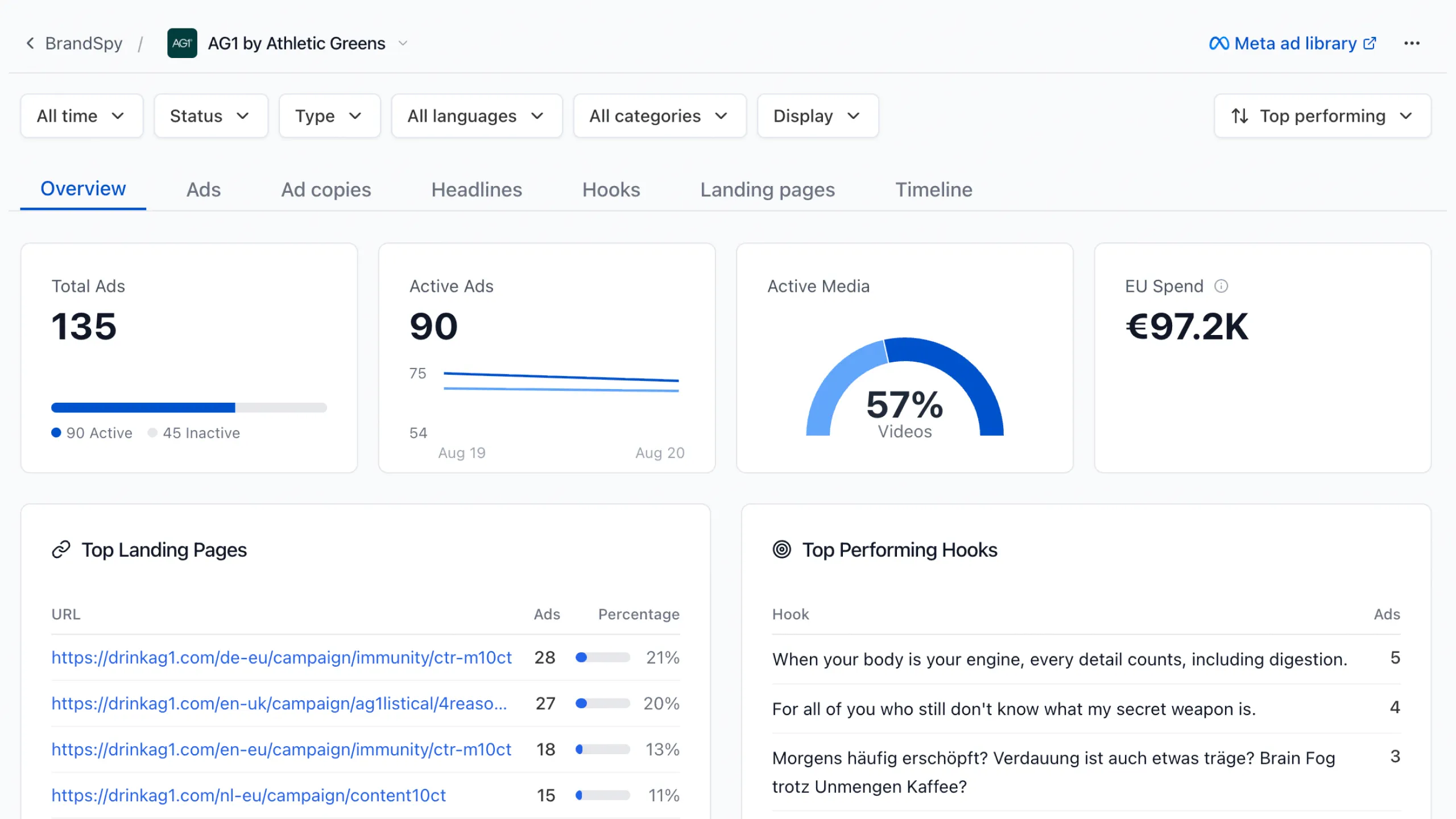
Add competitors to your Brand Spy dashboard and track their creative strategy in real-time. See what hooks they're testing and how long they run winners.
Clone Winning Structures
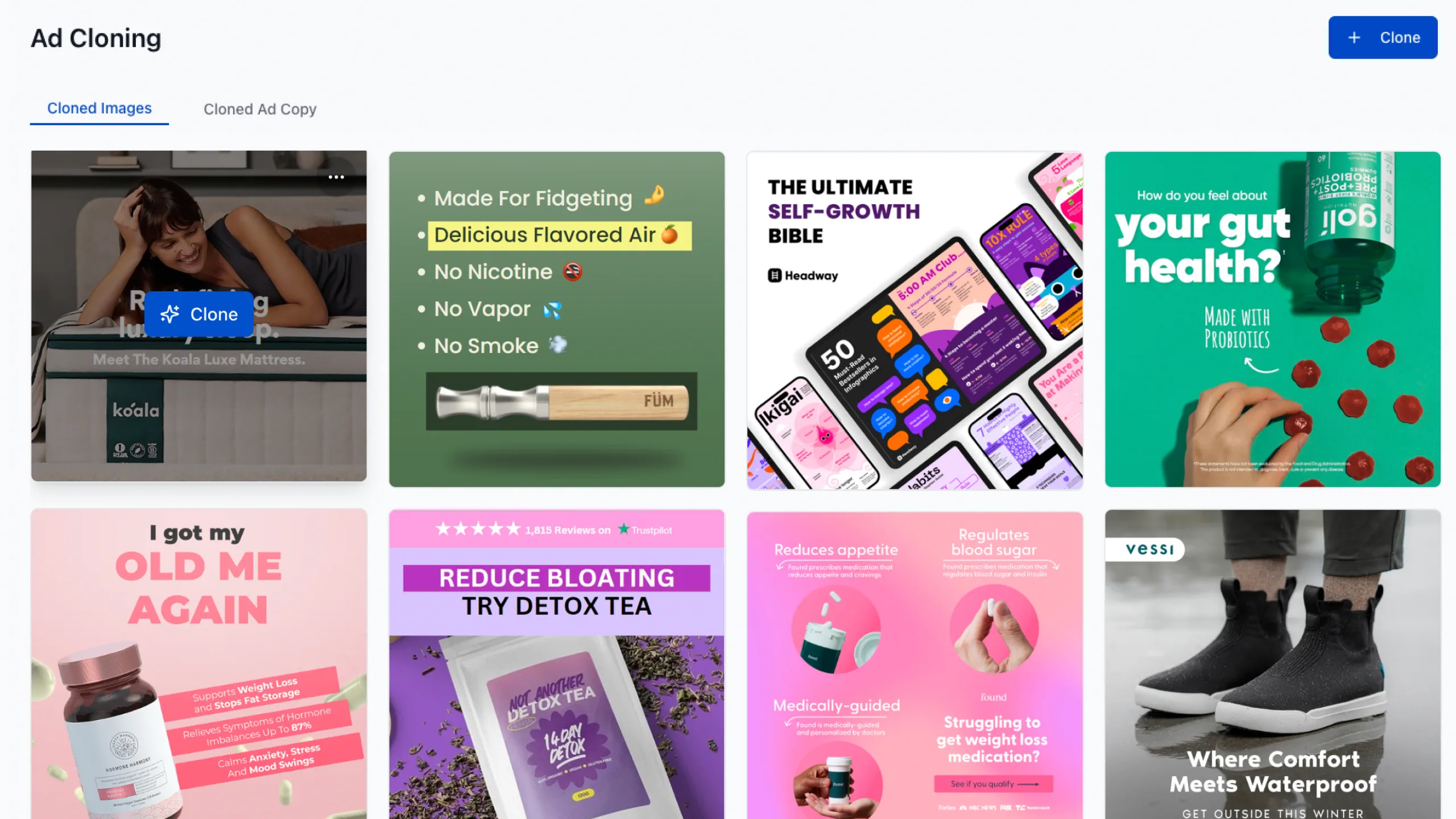
Once you identify winning ad patterns, use AI Ad Cloning to create variations adapted to your brand and products.
Test at Scale
Start with 10-20 variations per concept. Kill losers fast, scale winners hard. These top brands aren't guessing — they're testing everything.
Analyze Performance by Hook
Use Creative Analytics to see which hooks, formats, and creative angles drive actual conversions — not just clicks.
Start Scaling Your Creative Like the Top 1%
The brands in this list don't have secret strategies — they just execute fundamentals at scale with disciplined testing and data-driven decisions.
You can do the same.
👉 Try Skaler free for 14 days and start tracking, analyzing, and creating ads like the top performance brands.
No credit card required.
Get Help
Questions about ad strategy or Skaler features?
- In-app support: Click the help icon in the bottom right
- Email: hello@skaler.app
Ready to scale your creative production? Get started with Skaler
Related Articles
The 80 Most-Saved Meta Ads of August 2026 (Free Swipe File)
We tracked the 80 Meta ads media buyers saved the most this month — from Seed and Loop to AI soap operas running across 9 ad sets. Browse all 80 free, plus the 4 patterns behind them.
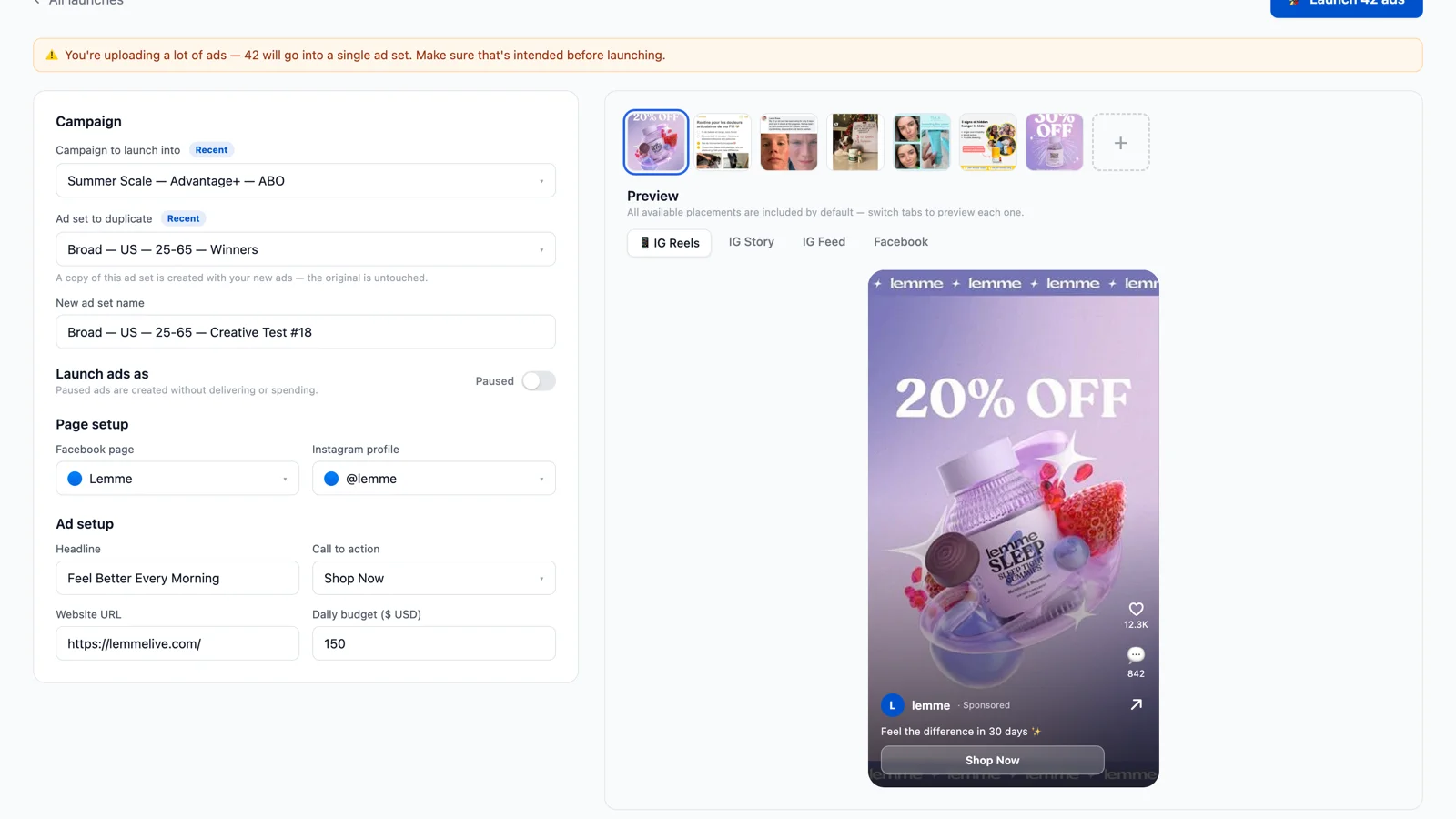
Bulk Ad Launcher for Meta: Launch 100 Facebook Ads in One Click
Skaler's new Bulk Ad Launcher takes you from creatives to live Facebook ads in minutes — drag and drop up to 100 files, duplicate a winning ad set, and launch with copy, budgets, and tracking auto-filled.