
Black Friday 2026 on Meta: Data From 35,052 Ads vs 2025
We matched 35,052 Black Friday Meta ads from 314 brands against 2025: ads started a median 9 days earlier, 29% of new ads now mention Black Friday, and the typical brand leads with 50% off.

 Follow on LinkedIn
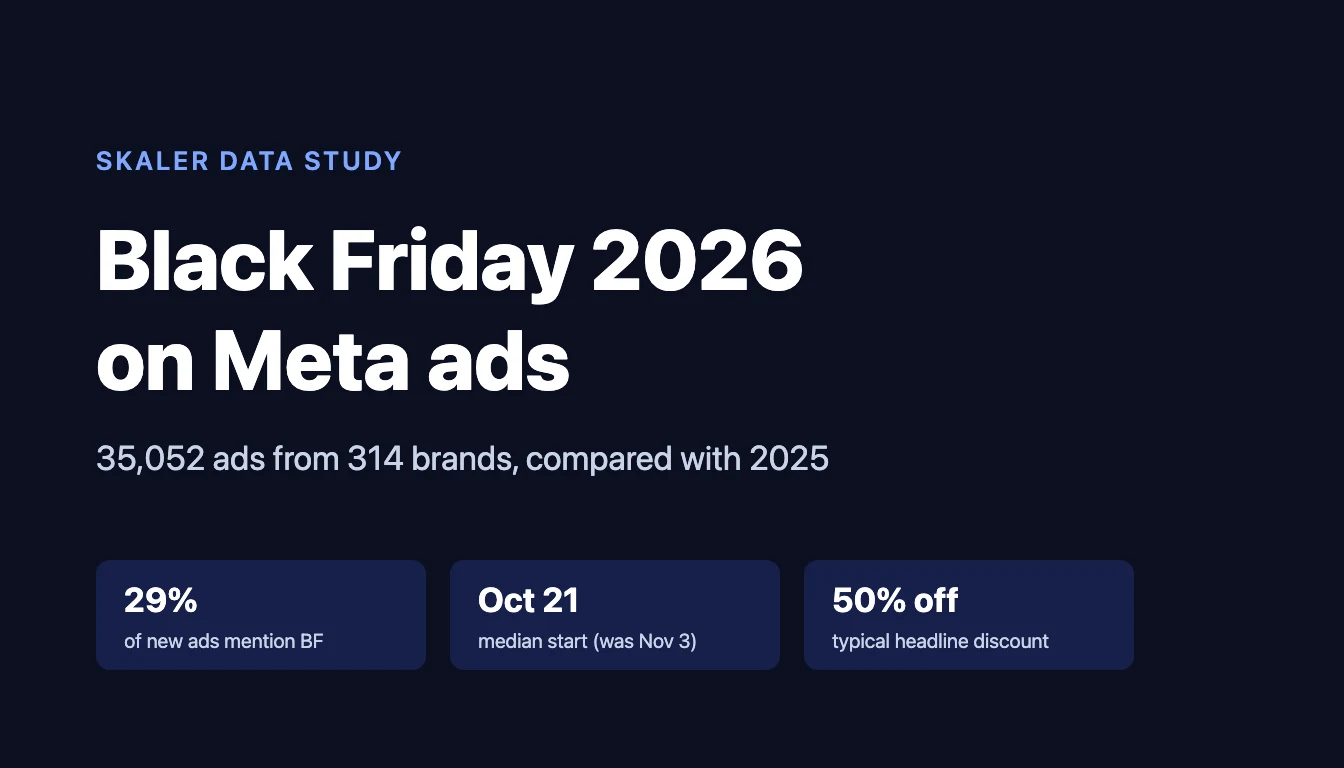
Black Friday ads showed up earlier this year, in bigger numbers, and with more stacked offers than in 2025. We counted 35,052 of them.
TL;DR: We matched every Meta ad launched between October 1 and November 20, 2026 in Skaler's ad library against Black Friday terms and compared it with the same window in 2025. Black Friday ads made up 8.8% of all new ads this year, up from 5.7%. In the week of November 16, 29% of all new ads mentioned Black Friday, against 18% in the same week last year. Brands we tracked in both years started their Black Friday ads a median of 9 days earlier (October 21 instead of November 3). The typical brand leads with 50% off, and about half of brands now write "up to X%" in their ads, nearly double last year's share.
Every November the same question comes up in media-buying Slack groups: are we late? This year we can answer it with data instead of vibes. Skaler collects public ads from the Meta Ad Library for the brands our users track, which gives us a large, mostly DTC and ecommerce sample of what brands actually launch. Below is what Black Friday 2026 looks like on Facebook and Instagram so far, how it compares with 2025, and what that means for the next ten days.
How many Black Friday ads are running on Meta in 2026?
Between October 1 and November 20, 2026, 314 brands launched 35,052 Meta ads that mention Black Friday, BFCM, Black Week, Cyber Week or Cyber Monday. That's 8.8% of the 396,725 new ads in our library over those seven weeks.
For the same dates in 2025, the numbers were 21,356 Black Friday ads from 266 brands, or 5.7% of 374,879 new ads. Our library covers a different set of brands each year, so the share is the fairer comparison than the raw count: the Black Friday share of new ads is up by more than half (5.7% to 8.8%).
The volume is also concentrated. Five advertisers account for 49.5% of all 2026 Black Friday ads in the sample, compared with 25.5% at the same point last year:
| Brand | Black Friday ads launched, Oct 1 to Nov 20, 2026 |
|---|---|
| Comfrt | 7,347 |
| Blackroll | 4,120 |
| Tibatoes | 2,760 |
| HexClad | 1,842 |
| Montessori Generation | 1,275 |
The median brand launched 7 Black Friday ads. Counts are Meta ad IDs, so one creative duplicated into many ad sets counts several times. A brand with thousands of ad IDs is running many variations and markets in parallel, not thousands of different concepts. Because a few brands dominate the ad count, most of the comparisons below are per brand rather than per ad.
When do brands start their Black Friday ads?
Earlier than last year. Two measures point the same way:
- 22.9% of this year's Black Friday ads launched before November 1, compared with 9.4% at the same point in 2025.
- Same-brand comparison: 31 brands were in our library well before the 2025 season (since before September 2025) and ran Black Friday ads in both years. 22 of them (71%) launched their first Black Friday ad earlier in 2026, 6 launched later and 3 on the same date. The median first Black Friday ad moved from November 3 to October 21, a median shift of 9 days earlier.
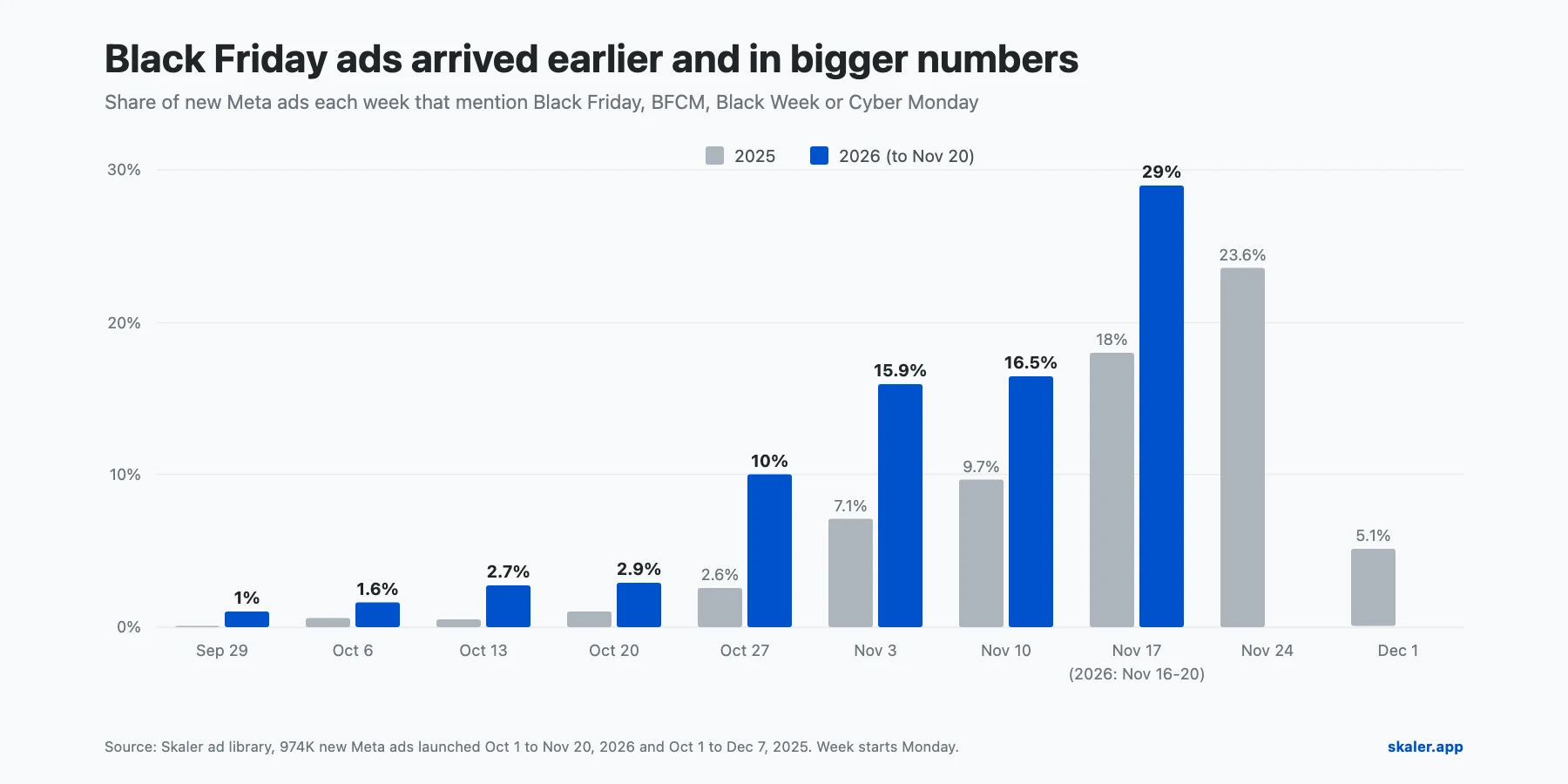
Weekly, the curve has the same shape as last year, shifted up. In the week of October 27, 10% of new ads mentioned Black Friday (2.6% in 2025). In the week of November 16 to 20, it was 29%, already above 2025's highest week (23.6%, the week of Black Friday itself).
Oddly, brands start earlier but call it "early" less. 15.9% of brands used "early Black Friday" or "early access" wording at least once, compared with 19.9% at this point last year. The early start has become the default rather than a hook.
What discounts are brands advertising for Black Friday 2026?
243 of the 314 brands state a percentage off in at least one Black Friday ad. For each brand we took the largest "% off" in each ad, then the median across that brand's ads, so a brand with 7,000 ads counts once.
- The typical brand leads with 50% off (median across brands). The middle half of brands sit between 30% and 58%.
- At the same point in 2025 the median was 45%, with the middle half between 30% and 55%.
- 51% of brands lead with 50% off or more, and 23% with 60% or more.
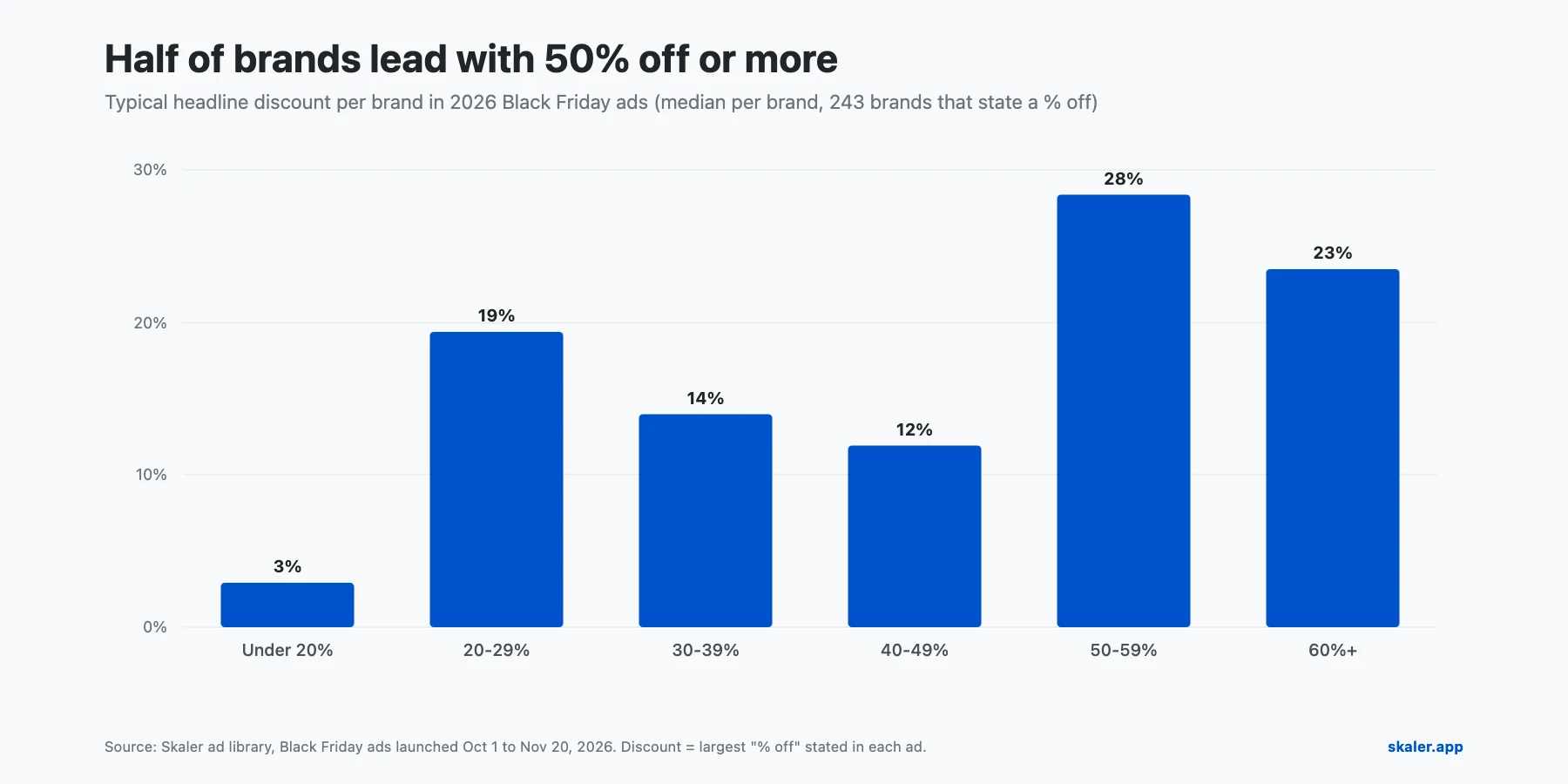
The distribution has two humps: a cluster of brands in the 20-29% range and a larger one at 50% and above, with fewer brands in between. Brands mostly either keep the discount modest or go to half off.
Which Black Friday offer tactics are brands using?
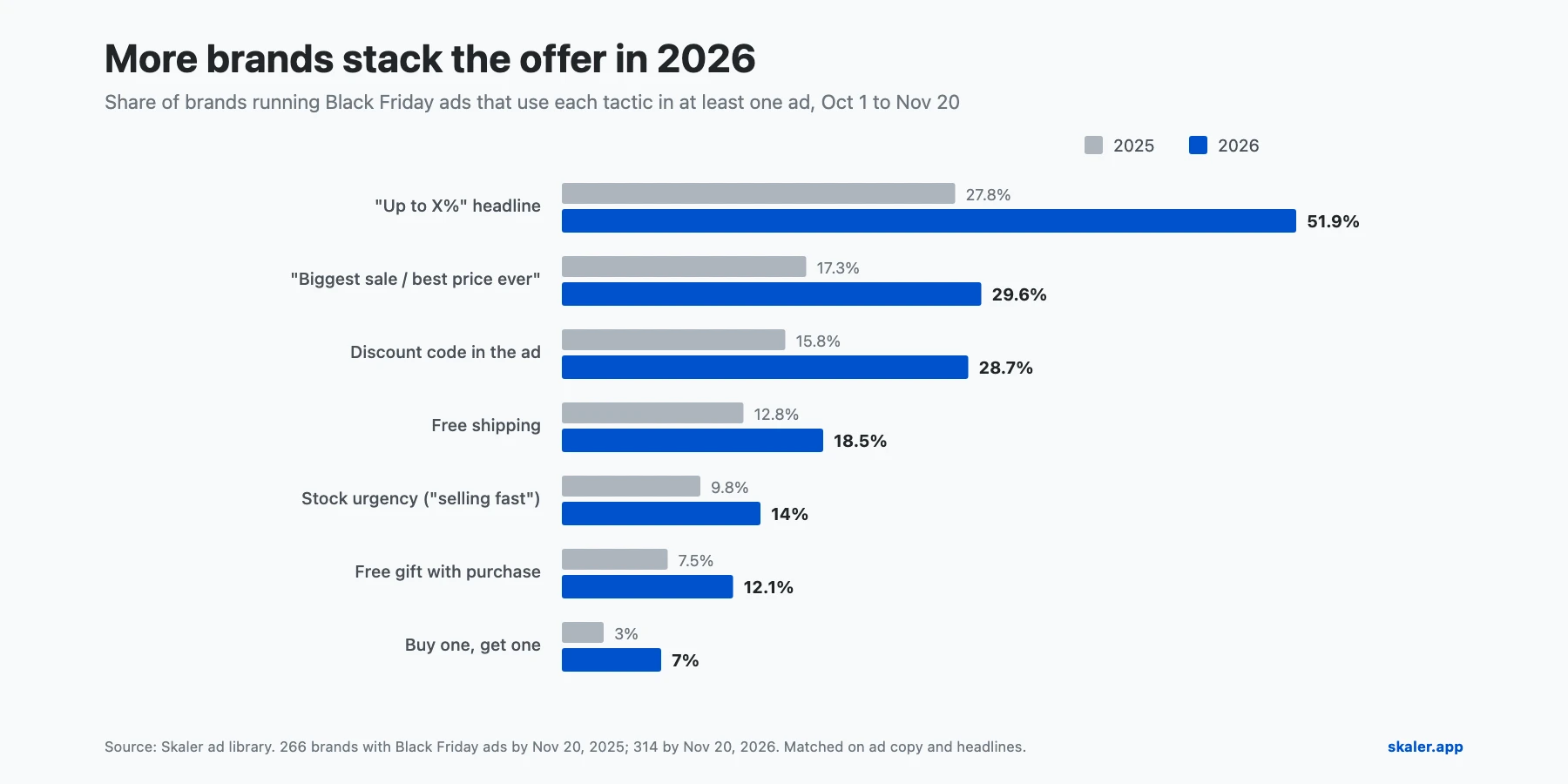
More of them, stacked together. We checked each brand's Black Friday ads for common offer and urgency patterns and compared the share of brands using each one with the same window in 2025.
| Tactic (in at least one ad) | 2025 brands | 2026 brands |
|---|---|---|
| "Up to X%" headline | 27.8% | 51.9% |
| "Biggest sale" / "best price ever" | 17.3% | 29.6% |
| Discount code in the ad | 15.8% | 28.7% |
| Free shipping | 12.8% | 18.5% |
| Stock urgency ("selling fast", "limited stock") | 9.8% | 14.0% |
| Free gift with purchase | 7.5% | 12.1% |
| Buy one, get one | 3.0% | 7.0% |
Three things stand out:
- "Up to" has become the default framing. About half of brands now say "up to X%". It lets a brand put its biggest number in the ad while most products sit at a lower discount, which also explains part of the jump in headline discounts.
- Codes moved into the creative. Nearly 3 in 10 brands now print a discount code in the ad itself, up from 1 in 6. That can help with attribution and with shoppers who screenshot the ad and buy later.
- Gifts and BOGO are rising from a small base. Both roughly doubled. They protect the headline price, which matters more for brands that can't keep going lower each year.
What didn't change: about 55% of brands' Black Friday ads are video, in both years, and almost none of the Black Friday creative is reused across ten or more ads (around 1-2% per brand). Black Friday is mostly new, short-lived creative, which leads to the last point.
How long do Black Friday ads run?
We can't answer this for 2026 yet, but 2025 shows the pattern. Across 53,947 Black Friday ads launched between October 1 and December 31, 2025:
- The median Black Friday ad ran 5 days. 80% were off within 13 days and 90% within 21 days.
- The week of Black Friday itself (November 24) saw 37% of the whole season's new Black Friday ads, and new launches fell by three quarters the following week.
- After Cyber Monday most brands switch off fast, but not all: the average brand still had about a quarter of its Black Friday ads stopping after December 7.
For context, the median Meta ad of any kind in 2025-2026 ran 3 days in our creative fatigue study of 2.9M ads. Black Friday ads are short-lived by design, so there's no reason to save your best concept for the final week. The data says the window opened in October.
What this means for your Black Friday ads this week
- You're not too late, but you're not early. By November 20, 29% of new ads in the auction mentioned Black Friday. If you're launching now, launch everything you have this weekend instead of trickling creatives out through the week. Last year's peak week was the week of Black Friday itself, and this year is running about a week ahead.
- A big number alone won't stand out. Half of brands say "up to X%" and half lead with 50% off or more. If your discount is in that range, the number is table stakes. Give a reason or a stacked offer (gift, bundle, code) that the 50%-off wall doesn't have. Our Black Friday ad examples show what that looks like in real ads.
- Plan for 5-day creative. The median Black Friday ad last year lasted 5 days. Build several variations of the winning offer (hooks, formats, first frames) rather than one polished hero ad.
- Check what your competitors already launched. The brands in your niche have probably been live since October. Brand Spy shows what a competitor is running and scaling, the free competitor ads finder lists every live ad a brand runs, and the Facebook ad downloader saves any of them as an MP4 or image for your swipe file.
Methodology
- Source: Skaler's ad library, which stores public Meta Ad Library data for the brands Skaler users track. The sample leans towards DTC and ecommerce brands and towards ads with EU reach data. It is not a census of all Meta advertisers.
- Windows: ads with a creation date from October 1 to November 20, 2026, compared with October 1 to November 20, 2025 (same-date comparisons) and October 1 to December 31, 2025 (full-season figures). Pulled on November 21, 2026.
- Matching: an ad counts as a Black Friday ad if its primary text or headline contains "Black Friday", "BFCM", "Cyber Monday", "Black Week" or "Cyber Week" (case-insensitive, with or without the space). Ads that only show the phrase in the image or video are missed, so the counts are a lower bound.
- Discounts: the largest percentage in an ad written as "X% off" (or "save / up to / -X%", plus common German, Dutch, French and Spanish forms), between 5% and 90%. Per brand we use the median of those values.
- Tactics: phrase matching on ad copy and headlines, counted as the share of brands that used the tactic in at least one Black Friday ad.
- Run time: start to stop date of inactive ads as reported by Meta.
- Counts are Meta ad IDs, so duplicates of one creative count separately. That's why we report most findings per brand.
The charts on this page are free to use in your own articles and newsletters with a link to this page as the source.
Frequently Asked Questions
When do brands start Black Friday ads on Meta? In 2026 the median brand in our sample launched its first Black Friday ad on October 21, 9 days earlier than in 2025 (November 3). 22.9% of all Black Friday ads up to November 20 launched in October, compared with 9.4% at the same point last year.
What percentage of Meta ads mention Black Friday? From October 1 to November 20, 2026, 8.8% of new Meta ads in Skaler's library mentioned Black Friday, BFCM, Black Week or Cyber Monday, up from 5.7% in the same window of 2025. In the week of November 16, the share reached 29%.
What is the average Black Friday discount in 2026? Among 243 brands that state a percentage off in their Black Friday Meta ads, the median brand leads with 50% off (middle half: 30% to 58%), up from 45% at the same point in 2025. 51% of brands lead with 50% off or more.
How long do Black Friday ads run on Facebook and Instagram? In 2025 the median Black Friday ad on Meta ran 5 days. 80% stopped within 13 days and 90% within 21 days. Launches peaked in the week of Black Friday itself, with 37% of the season's new Black Friday ads.
Which Black Friday ad tactics grew the most in 2026? "Up to X%" framing (used by 51.9% of brands, up from 27.8%), discount codes in the ad (28.7%, up from 15.8%), "biggest sale" or "best price ever" claims (29.6%, up from 17.3%), and free gifts (12.1%, up from 7.5%).
See What Your Competitors Launch for Black Friday
Skaler shows which Meta ads are winning and why: hooks, angles, formats and ROAS in your own account, plus competitor ad research with Brand Spy, ad discovery and a saved-ads library. It also works inside Claude and ChatGPT through the Skaler MCP server.
Related Resources
Related Articles
Supplement Meta Ads, Nov 2026: What 6 Brands Scale in 2,468 Ads
AG1, Happy Mammoth, ColonBroom and three more supplement brands ran 2,468 Meta ads and launched 5,354 in 30 days. Only 16% of sampled ads are scaled; AG1's top creative runs in 20 ads.
Meta Marketing API: Access, Tokens, Rate Limits & Insights (2026)
How to use the Meta (Facebook) Marketing API: get access, pick the right token, handle rate limits, pull reporting with the Insights API and create ads paused.