
Best Facebook Ad Reporting Tools for 2026: 13 Tools Compared (Free + Paid)
The 13 best Facebook ad reporting tools for 2026, ranked for performance marketers — including the new attribution-window changes, free options, and a clear decision matrix by spend level and use case.

 Follow on LinkedIn
The best Facebook ad reporting tools for performance marketers, agencies, and DTC brands in 2026, ranked by what actually moves ROAS (not by who has the prettiest dashboard).
TL;DR: Native Facebook Ads Manager underreports your real performance in 2026, and the gap is now structural. This guide compares the 13 best Facebook ad reporting tools (free and paid) for performance marketers, with a clear decision matrix by spend level and use case. Skim the table of tools, jump to the matrix, pick one attribution platform plus one creative analytics tool, and you're set.
If you're still relying on Facebook Ads Manager to report on your campaigns in 2026, you're flying half-blind. On January 12, 2026, Meta permanently removed the 7-day-view and 28-day-view attribution windows from the Ads Insights API. Then in March 2026, they redefined what counts as a "click," moving social interactions to a separate engage-through bucket with a 1-day window. Some accounts saw reported conversions drop 30-40% overnight, and that's before you factor in pixel-only tracking now capturing just 40-60% of actual conversions, the 8-event-per-domain cap on iOS, and conversions taking up to 72 hours to settle.
In other words: the right Facebook ad reporting tool isn't a nice-to-have anymore. It's the difference between scaling profitably and shutting off campaigns that are quietly making you money.
This guide ranks 13 Facebook ad reporting tools (free and paid) by what we actually use them for as performance marketers. We'll cover what's broken with native reporting, what to look for, and a clear decision matrix at the end so you don't waste a free trial.
What's broken with Facebook Ads Manager in 2026?
In 2026, native Ads Manager underreports your real performance by 15-40% on most accounts due to permanent attribution-window changes, iOS opt-outs, and ad blockers. It's still useful for editing campaigns and tracking spend in real time, but it can't be your single source of truth for ROAS, creative performance, or cross-channel decisions.
Here's why a dedicated Facebook ad reporting tool is non-negotiable now, even if you're spending $5K/month and not $500K.
1. Attribution gaps are structural, not temporary. Meta has consistently underreported conversions by 15-30% since iOS 14.5, and that's a permanent feature of the post-cookie web. No update is going to fix it. Your reporting tool needs to fill that gap with first-party data, server-side events, or post-purchase surveys.
2. Settling delays make real-time decisions dangerous. Conversions can take 72+ hours to populate. If you make a kill decision on Day 1, you're often killing winners. A good reporting tool flags "still settling" data so you don't pull the trigger early.
3. The 8-event cap forces brutal trade-offs on iOS. You can only track 8 prioritized conversion events per domain. Most brands waste this on weak signals (page views, button clicks). A good reporting tool helps you see which events are actually moving revenue so you prioritize correctly.
4. Native reporting can't compare creatives at scale. Ads Manager shows you metrics, not the creative next to the metrics. When you have 200 active ads, scrolling through tiny thumbnails to find your winners is the bottleneck (not the analysis).
5. Cross-channel reality is missing. If your buyer touches your TikTok ad, then your Meta ad, then converts on a Klaviyo email, Ads Manager will claim or deny the sale depending on the wind. You need a tool that reconciles across channels.
If you've been seeing weird dips in your reported ROAS lately, our breakdown of why Facebook ads aren't converting in 2025/2026 walks through the most common attribution-related causes.
What should you look for in a Facebook ad reporting tool?
Look for five things: creative-level analytics with the creative visible inline, CAPI-aware attribution that doesn't rely on the pixel alone, real benchmarks against accounts in your vertical, sub-5-second load times on creative-level views, and a clear path from "I found a winner" to "I shipped 5 variations." Anything missing one of these will leak time or money in 2026.
A modern Facebook ad reporting tool should hit at least these five marks:
- Creative-level analytics, not just campaign-level. Creative is responsible for the majority of ad performance, so your reporting needs to show CTR, hook rate, hold rate, and ROAS per creative, with the creative visible inline.
- First-party / CAPI-aware attribution. Pixel-only is dead. Pixel-only tracking captures just 60-70% of conversions, so look for tools that integrate with Conversions API, post-purchase surveys, or first-party pixel tech (Triple Pixel, Hyros tracking).
- Real benchmarks against other accounts in your vertical. A 2x ROAS could be killing it or a disaster, depending on your category. The best tools (Madgicx, Triple Whale, Skaler) show you anonymized benchmarks.
- Faster than Ads Manager. If your reporting tool takes longer than 5 seconds to load a creative-level view, it's a worse experience than the native one. Speed is a feature.
- Actionable, not just observational. Spotting a winning ad is half the job. The other half is making more of it. Tools that connect reporting to creative production (or to your design team) compress your iteration loop.
🔍 Skaler combines creative analytics with built-in ad spying and one-click ad cloning, so when you find a winner in your reports, you can ship 5 new variations the same day. Try it free →
What are the best Facebook ad reporting tools for 2026?
The best Facebook ad reporting tools for 2026 are Skaler (creative analytics + competitor intel), Triple Whale (Shopify DTC attribution), Northbeam (enterprise multi-touch attribution), Hyros (long-cycle revenue attribution), Motion (creative analytics), Whatagraph (agency client reports), and Looker Studio (free baseline). Below, all 13 ranked roughly by usefulness for performance marketers.
1. Skaler. Best for creative analytics and intel in one place
Best for: DTC brands and agencies that want creative analytics and the ability to act on what they find.
Skaler connects to your Meta Ad Account and surfaces a creative-first view of your performance: every ad, ranked by ROAS, hook rate, CTR, and spend, with the creative visible right next to the numbers. Reports load in under a second (vs. ~1 minute on most competitors). Where Skaler stands out is the layer on top: built-in Brand Spy to see what competitors are running, and AI Ad Cloning to spin up 5+ on-brand variations of any winning ad in minutes.
What's good:
- Creative analytics with thumbnails, hook rate, hold rate, ROAS, all sub-second loads
- Every creative is tagged with hook, watch, click and convert score
- Every ad is grouped by visual format, asset type, hook, messaging angle, persona and more
- Tracks ads that are currently running (most analytics tools miss this)
- Hyros data ingestion (so you see real revenue, not pixel-attributed revenue). See our Hyros integration
- Built-in competitor ad library + AI ad cloning, so you don't need a second tool
- 100% accurate data sync (most tools have noticeable drift)
- Flat $99/mo with no ad spend tax like other tools
What's not:
- New to the analytics-only category, has fewer agency-style branded report templates than Whatagraph or DashThis (we don't try to compete in that lane)
- No SQL editor or warehouse ingestion (use Funnel.io for that)
Pricing: Starts at $99/mo, unlimited users included.
Verdict: If you're a DTC brand or agency running Meta ads and you spend more time looking at creatives than building stakeholder PDFs, this is the highest-leverage tool you can install. The fact that you can go from "this hook is winning" to "5 cloned variations in your design queue" inside the same product is the differentiator.
2. Triple Whale. Best DTC attribution for Shopify brands
Best for: Shopify DTC brands at $1M+ GMV.
Triple Whale is the de facto standard for DTC attribution in 2026. The Triple Pixel captures first-party events, the Shopify integration pulls native order data, and Moby AI lets you ask questions like "Why did our Meta ROAS drop last week?" in plain English. Where it shines: closing the gap between Meta's reported revenue and your actual Shopify revenue.
Triple Whale restructured pricing in late 2025. The new structure:
- Founders Dash: $0/mo. Real-time metrics, basic post-purchase survey, and first/last-click attribution. Surprisingly usable for sub-$30K/mo media spend.
- Starter: $179/mo (scales with GMV). Pixel tracking, multi-touch attribution, post-purchase surveys, Sonar Send.
- Advanced: $259/mo. Total Impact Attribution (their first-party + platform-blended model), creative analytics, cohort analysis.
- Professional: $749+/mo. SQL Editor + Marketing Mix Modeling.
- Custom (Enterprise): $539+ per module for $20M+ GMV brands.
Pricing scales with GMV. A $5-7M GMV brand can expect ~$1,129/mo.
Verdict: If you're on Shopify, the free Founders Dash is a no-regret install today. Upgrade to Starter once you cross $30K/mo in spend and need MTA. Brands not on Shopify get less value.
3. Northbeam. Best multi-touch attribution for $250K+/mo spend
Best for: DTC brands spending $250K-$500K+/month on paid media.
Northbeam is enterprise-grade attribution and the default choice once your media spend gets too big for Triple Whale to be the primary brain. Their Clicks + Deterministic Views model (launched October 2025) is the first deterministic view-through attribution in the category, connecting ad views to real revenue using deterministic matching across Meta, TikTok, and CTV.
What's good:
- Industry-leading MTA + media mix modeling (MMM+)
- Apex AI feeds attribution data back to ad platforms to optimize bidding
- Infinite lookback windows (rare since Meta killed 28-day-view)
- Unlimited users and integrations
What's not:
- Starts at $1,500/mo, not a tool for sub-$50K/mo brands
- No free trial (book a demo to see it)
- Annual contracts standard at higher tiers
Pricing: $1,500/mo Starter (under $250K/mo spend). Professional and Enterprise are custom-quoted.
Verdict: If you're spending $250K+/month and you want a single source of truth for attribution that you can actually defend to a CFO, Northbeam is worth the cost. Below that spend level, the cost-per-insight doesn't pencil out.
4. Hyros. Best revenue attribution for info products and high-ticket
Best for: Coaches, consultants, course creators, and high-ticket DTC brands where the customer journey is long and email/SMS-heavy.
Hyros tracks customers across their full journey using server-side pixel tech and attribution that goes far beyond Meta's defaults. Where it shines: understanding which Meta ad actually drove the $5,000 program sale that came in 23 days later via your sales team's outbound call. That's invisible in Ads Manager. It's table-stakes in Hyros.
We've integrated Hyros directly into Skaler (see our Hyros integration breakdown) so you can pull real Hyros revenue numbers next to creative-level analytics.
Pricing: Starts at $199/mo (scales with tracked revenue). Most info-product businesses end up paying $499-$999/mo.
Verdict: If your AOV is $500+ and your sales cycle is longer than a week, Hyros pays for itself the first month. If you're a $40 t-shirt brand, it's overkill (Triple Whale is the better fit).
5. Motion. Solid creative analytics
Best for: Creative teams in mid-market DTC who want a creative-led analytics dashboard.
Motion is the best-known dedicated creative analytics tool for Meta and TikTok. Strong reporting, good collaboration features between media buyers and creatives, and they popularized the modern creative analytics dashboard format.
What's good:
- Deep creative reporting; tags, comparisons, format breakdowns
- Free tier for solo freelancers
- Big-name DTC clients (MUD\WTR, Vuori)
What's not:
- Analytics only. When you find a winner, you still need a separate tool to make more of it (most teams use Canva, Figma, or hand off to a designer)
- Reports load slowly at scale (~1 minute on large accounts is common)
- Enterprise pricing is steep and quote-based; the free tier is intentionally limited
- No competitor ad spy or AI ad cloning
Pricing: Free tier for freelancers; mid-market and enterprise pricing requires a sales call. Most teams we've heard from end up paying $250-$2,000+/mo.
Verdict: Motion is a competent product and an obvious choice if you only need creative analytics. If you also want competitor ad intel and AI ad creation, see how Skaler compares as a Motion alternative.
6. Madgicx. AI-driven ad management with reporting baked in
Best for: Mid-market brands who want ad management, reporting, and automation in one place.
Madgicx is a self-described "SuperApp" for Facebook ads with AI-driven optimization, audience creation, and automated workflows. Reporting is one of several features rather than the core product.
What's good:
- Competitive pricing ($55-$149/mo)
- Decent AI-backed insights and bid automation
- All-in-one for buyers who don't want to stitch tools together
What's not:
- Steeper learning curve than focused tools
- Some reports can be hard to decipher
- Customer reviews mention semi-frequent technical issues
Pricing: $55-$149/mo depending on plan and ad spend.
Verdict: Good fit if you want one tool for both ad management and reporting and you're willing to invest a week to learn it. If you just need clean reporting, lighter-weight tools are easier.
7. Whatagraph. Best for agencies that send client reports
Best for: Marketing agencies managing 5+ Facebook ad accounts and sending branded reports to clients.
Whatagraph is built around two things: fully managed integrations (45+) and white-labeled, drag-and-drop client reports. Their Facebook Ads reporting tool is one of the cleanest agency-side experiences out there. They've also added two AI features: an AI chatbot that answers questions about your data, and AI-generated performance summaries you can paste into reports.
Pricing: Custom-quoted, starts around €219/mo. Scales with the number of integrations and users.
Verdict: Best agency-side reporting tool on this list. If you're not running an agency, you don't need it (most of the value is in client-facing report generation).
8. DashThis. Friendliest agency dashboard
Best for: Smaller agencies and freelancers who want pretty dashboards without complexity.
DashThis is the user-friendly agency dashboard. 34+ native integrations, lots of templates, unlimited users on a single account, and an interface that even non-technical clients can decipher.
Pricing: Starts at $42/mo, scales with team size and integrations.
Verdict: A solid pick for an SMB agency or freelancer. Less powerful than Whatagraph, but cheaper and faster to set up.
9. Swydo. Affordable agency dashboards
Best for: SMBs and mid-market agencies that need cross-channel ad reporting on a tight budget.
Swydo started as a marketing agency, which shows in the workflow. Drag-and-drop reports, pre-built templates, decent automation. Less polished than DashThis, but cheaper.
Pricing: Starts at $49/mo, scales with data sources.
Verdict: Fine if you've outgrown free options but can't justify Whatagraph. Their data visualization options are limited compared to newer tools.
10. Looker Studio (free). Best free Facebook ad reporting tool
Best for: Anyone who needs a free, customizable Facebook ad dashboard.
Looker Studio (formerly Google Data Studio) is Google's free dashboarding tool. There's no native Facebook Ads connector, so you need a third-party connector. Most marketers use Porter Metrics, Data Bloo, or Windsor.ai, all of which have free tiers.
What's good:
- Truly free baseline (with free connector tier)
- Fully customizable
- Plays nicely with Google Sheets, BigQuery, and GA4
- Plenty of free Facebook Ads templates available
What's not:
- No creative-level analytics out of the box (you build your own dashboard)
- Connectors silently break when Meta deprecates fields (e.g. tools still pulling
7d_viewafter January 2026 are returning empty data) - Setup time is real. Expect to spend a half-day to get your first dashboard usable
Pricing: Free for Looker Studio + free tier for most connectors (e.g. Porter Metrics free includes 3 ad accounts and 30-day history).
Verdict: If you're below $5K/mo in spend or budget-constrained, this is the best free Facebook reporting tool that exists. Don't expect creative analytics.
11. Funnel.io. Best for warehousing your ad data
Best for: Mid-market and enterprise brands who want their ad data in BigQuery or Snowflake.
Funnel.io is a marketing data platform. It pulls data from 500+ sources (including Facebook Ads), normalizes it, and pipes it into your warehouse, BI tool, or Looker Studio. Less of a "reporting tool" and more of "the pipeline beneath your reporting tool."
Pricing: Custom-quoted; most teams pay $1,000+/mo.
Verdict: Worth it once your reporting needs cross multiple platforms and stakeholders. Not the right starting point.
12. Supermetrics. Best Facebook ads connector for spreadsheets
Best for: Spreadsheet-native marketers and finance teams who want Facebook Ads data in Google Sheets or Excel.
Supermetrics is the OG marketing data connector. If your finance team lives in Sheets or your CFO insists on Excel-based dashboards, Supermetrics pulls Facebook Ads data into them with one click. They also offer destinations into BigQuery, Looker Studio, Power BI, and warehouses.
Pricing: Starts ~$99/mo per destination.
Verdict: A workhorse, not a reporting tool. Pair it with Sheets, Looker Studio, or Power BI for a custom solution.
13. Meta Ads Manager. The native baseline
Best for: Knowing what Meta thinks happened.
You can't ignore it. Every other tool on this list pulls data from the Ads Insights API. Native Ads Manager is your ground truth for what Meta itself thinks your campaigns did. After the January and March 2026 attribution changes, the new default is 7-day click + 1-day engage-through + 1-day view. Make sure your column setup matches, or your reports will silently undercount.
What's good:
- Free, included with any ad account
- The only place where you can actually edit campaigns
- Real-time spend tracking
What's not:
- No creative-level analytics worth using
- Modeled conversions are within 10-15% of reality but tend to underreport
- Attribution windows keep shrinking
- 8-event cap on iOS forces hard prioritization
- No cross-channel view
Verdict: Use it for what it's good at: campaign editing, real-time spend monitoring, and reconciliation. For everything else, layer one of the tools above on top.
What does "what's working" look like in your reporting tool?
A "what's working" view in your reporting tool should let you see your top 10 ads ranked by ROAS, with the creative visible inline, in under a second. That's it. If you can't get that view from your current tool, it's not a Facebook ad reporting tool, it's a dashboarding tool.
Here's what high-performing Facebook ads in spring 2026 actually look like. These are real, currently-running ads with EU reach in the 500K-7M range, all pulled live from Skaler:
Notice how different they are: a hooky demo walkthrough (Saily, eSIM app), a candid founder explaining product positioning (Huel), a transformation testimonial (IM8), and a problem/solution product demo (Rug Editorial). They share almost nothing in surface-level features, but a good reporting tool surfaces what they have in common in your account: thumbstop in the first 1.5 seconds, a clear single value prop, and a hook that addresses an objection rather than restating the offer.
That kind of analysis is impossible inside Ads Manager. It's why a creative-aware reporting tool (Skaler, Triple Whale, Motion, Madgicx) is worth more than a generic dashboarding tool for performance marketers. For a deeper take on how to actually analyze creative performance, see our full breakdown.
Which Facebook ad reporting tool should you choose?
For most performance teams, the right answer is two tools running side by side: one attribution platform (Triple Whale, Northbeam, or Hyros, picked by spend and platform) plus one creative analytics tool (Skaler is our pick, Motion is the closest alternative), with native Ads Manager as the editing surface. The matrix below shows which combo fits your situation.
Pick the row that matches your situation:
| Your situation | Use this | Why |
|---|---|---|
| Solo marketer or freelancer, < $5K/mo spend | Looker Studio + Porter Metrics free | Free, customizable, enough for one account |
| DTC brand, < $30K/mo spend, on Shopify | Triple Whale Founders Dash (free) | The free tier is genuinely useful |
| DTC brand, $30K-$250K/mo spend | Triple Whale Starter + Skaler | Triple Whale for attribution, Skaler for creative iteration |
| DTC brand, $250K+/mo spend | Northbeam + Skaler | Northbeam for MTA/MMM, Skaler for creative |
| Info-product / high-ticket / coach | Hyros + Skaler | Hyros for long-cycle attribution, Skaler for creative |
| Performance marketer who lives in creative | Skaler | Sub-second creative analytics + competitor spy + AI cloning |
| Agency sending branded client reports | Whatagraph or DashThis | Built for client-facing PDFs |
| You need data in a warehouse | Funnel.io | Pipes Facebook Ads to BigQuery / Snowflake |
| You live in Google Sheets | Supermetrics | Native connector, fast setup |
| You want one all-in-one with automation | Madgicx | Combines reporting + ad management |
If you only install one new tool this quarter, install the creative analytics layer. Attribution argues with itself. Creative analysis is unambiguous. The ad with the 4.5x ROAS and 8% CTR is your winner whether Meta says it converted 40 people or 50. Find it, clone it, scale it.
Frequently asked questions
What are the top 5 Facebook ads reporting tools?
For performance marketers in 2026, the top 5 are Skaler (creative analytics + spy), Triple Whale (Shopify DTC attribution), Northbeam (enterprise MTA), Hyros (long-cycle revenue attribution), and Whatagraph (agency client reports). Native Meta Ads Manager is the free baseline that all of these layer on top of.
Are there any free Facebook ad reporting tools?
Yes. Looker Studio + a free connector (Porter Metrics, Data Bloo, Windsor.ai) gives you a customizable dashboard at $0. Triple Whale's Founders Dash is also free and surprisingly useful for sub-$30K/mo Shopify brands. Motion has a free tier for solo freelancers. Beyond those, expect to pay $42-$249/mo for paid tools and $1,500+/mo for enterprise attribution.
Why does Facebook Ads Manager show different numbers than my Shopify or backend?
Because Meta uses different attribution rules than your backend does. Pixel-only tracking captures 40-60% of actual conversions post-iOS 14.5. Meta also models conversions for opted-out users (within ~10-15% accuracy). And as of January 12, 2026, Meta no longer supports 7-day-view or 28-day-view attribution windows, so any third-party tool still requesting them silently returns zeros. Always cross-reference Ads Manager with your backend revenue data.
Do I still need a Facebook ad reporting tool if I have Conversions API set up?
Yes. CAPI recovers 15-30% of lost conversion events and is mandatory for accurate tracking, but it doesn't solve the analysis problem. CAPI sends events; a reporting tool helps you understand which creatives, audiences, and placements are driving them. They're complements, not alternatives.
Triple Whale vs. Northbeam: which one?
Use Triple Whale if you're on Shopify and spending under $250K/mo. It has the deepest Shopify integration in the category and the free Founders Dash is genuinely useful. Use Northbeam if you're spending $250K+/mo, need media mix modeling, or aren't on Shopify. Both are credible at the high end; the cutoff is mostly about spend level and platform.
Is Motion worth it in 2026?
Motion is a competent creative analytics tool. The question is whether creative analytics alone is enough. Most teams find they also need competitor ad intel and AI ad cloning, which Motion doesn't have. If you want all three in one tool, Skaler is the closest alternative and is meaningfully cheaper.
The takeaway
Facebook ad reporting in 2026 is fundamentally different than it was even 12 months ago. Native Ads Manager has gotten worse (shorter attribution windows, more modeled conversions). Pixel tracking has gotten less reliable. And the gap between what Meta reports and what actually happened in your business is now structural, not solvable.
The right tool stack is one attribution platform (Triple Whale, Northbeam, or Hyros, picked by spend and platform), one creative analytics tool (Skaler is our pick, Motion is the closest alternative), and the native Ads Manager as your editing surface. Everything else is optional.
If you only install one new tool this quarter, install the creative analytics layer. The ad with the 4.5x ROAS and 8% CTR is your winner whether Meta says it converted 40 people or 50. Find it, clone it, scale it.
See your winning Facebook ads (and your competitors' winners) in one place
Skaler is the all-in-one performance marketing platform: creative analytics, competitor ad spy, and AI ad cloning in one tool. Reports load in under a second. You can see what's working in your account and what's working across 18,000+ brands we track on Meta, TikTok, and LinkedIn, then clone any winner into your brand style with AI in minutes.
Skaler turns reporting into action: find a winning creative in your dashboard, clone it into 5 on-brand variations, and ship them all the same day. Free to start, no credit card required →
Related Articles

The 80 Most-Saved Meta Ads of August 2026 (Free Swipe File)
We tracked the 80 Meta ads media buyers saved the most this month — from Seed and Loop to AI soap operas running across 9 ad sets. Browse all 80 free, plus the 4 patterns behind them.
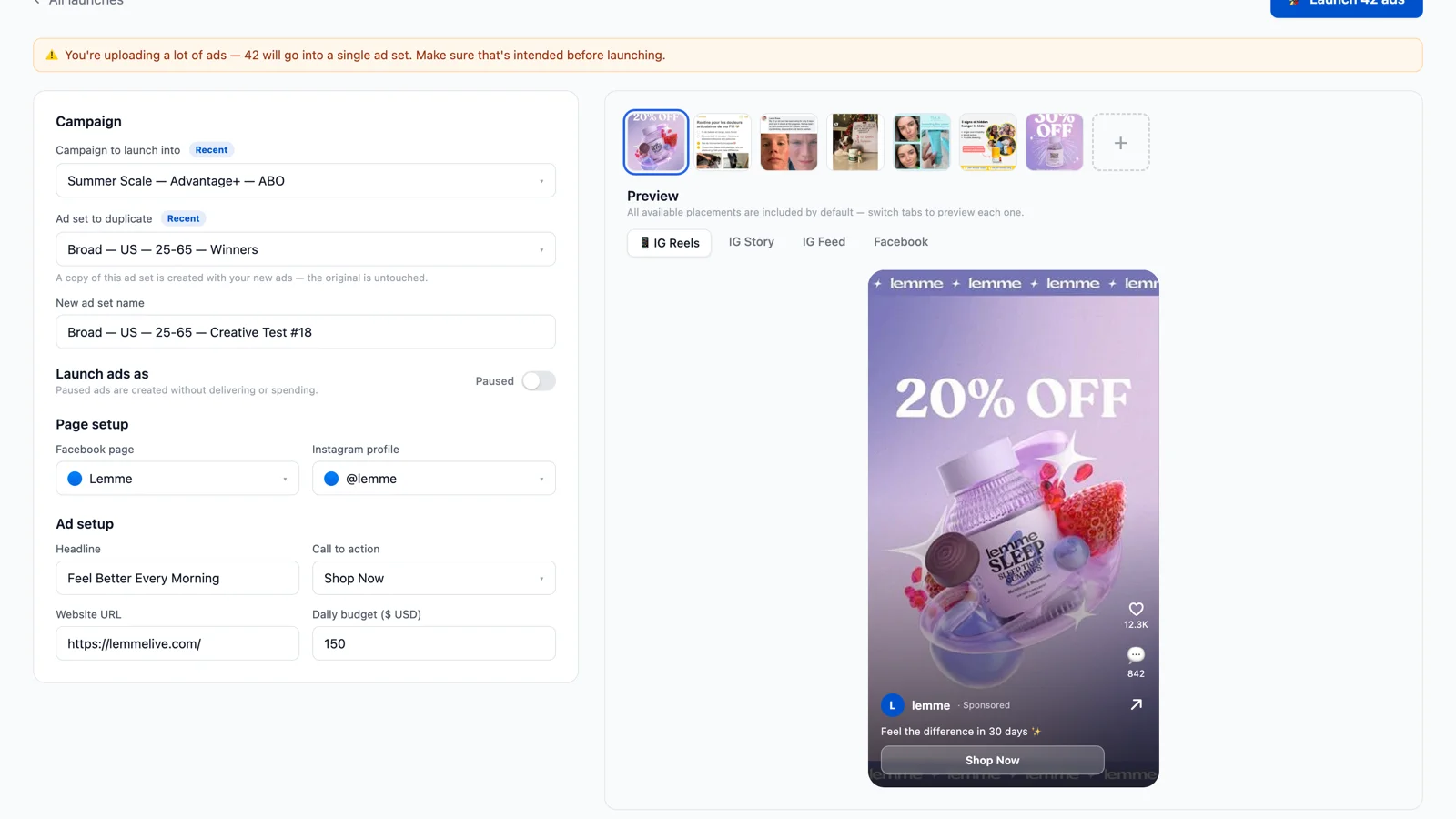
Bulk Ad Launcher for Meta: Launch 100 Facebook Ads in One Click
Skaler's new Bulk Ad Launcher takes you from creatives to live Facebook ads in minutes — drag and drop up to 100 files, duplicate a winning ad set, and launch with copy, budgets, and tracking auto-filled.