
Hook Rate Benchmarks 2026: What Good Looks Like on Meta and TikTok
What's a good hook rate on Meta and TikTok in 2026? 30%+ is solid, 35%+ is elite. The real benchmarks by tier and industry, plus why hooks now decide delivery.

 Follow on LinkedIn
A 28% hook rate used to be average. In 2026, it's quietly the dividing line between an ad that scales and one Meta never bothers to test.
TL;DR: A good hook rate on Meta in 2026 is 30% or above, with 35%+ qualifying as elite. On TikTok, the same tiers shift up by roughly 5 points because the platform measures at 2 seconds, not 3. Hook rate is the first signal Meta's Andromeda system looks at when deciding which ads earn distribution, so a weak opener kills the ad before conversion data ever arrives. Below: the full benchmark table by platform and industry, why hooks matter more in 2026 than they did in 2024, and five real ads built around the patterns that consistently break 35%.
If you've watched a creative die in 36 hours with three conversions and a 19% hook rate, you already know how this works in 2026. Meta no longer waits to see whether the ad converts. It looks at the first 3 seconds, decides whether the creative deserves more reach, and quietly throttles everything that fails the test. Hook rate isn't a vanity metric anymore. It's the gate.
This post is the practitioner's benchmark guide: what a good hook rate actually looks like on Meta and TikTok in 2026, how the tiers shift by industry, and the hook patterns currently breaking 35% in our database of high-reach ads.
What's a good hook rate on Meta and TikTok in 2026?
On Meta, a good hook rate is 30% or above (measured as 3-second video views divided by impressions). On TikTok, aim for the same 30% floor, but expect raw numbers 5 to 10 points higher because TikTok measures at 2 seconds, not 3. Below 20% on Meta or 25% on TikTok, the creative is functionally invisible to the algorithm.
Here are the working performance tiers from multi-account 2026 data:
| Tier | Meta (3-second) | TikTok (2-second) |
|---|---|---|
| Needs work | Below 20% | Below 25% |
| Table stakes | 20-25% | 25-30% |
| Competitive | 25-35% | 30-40% |
| Elite | 35%+ | 40%+ |
These ranges come from aggregated hook rate benchmark analyses covering ecommerce, DTC, and B2B verticals in early 2026. The median Meta ad lands at 28%, with the top 10% pulling 43%+. On TikTok, the top decile pushes 45%+, almost always with creator-led UGC content.
Two important caveats before you panic-screenshot the table:
- Hook rate is a diagnostic, not a scoreboard. A 28% hook rate with 4x ROAS is healthier than a 42% hook rate that draws curiosity clicks and zero purchases. Always read it next to hold rate and CPA.
- The benchmark is industry-relative. DTC beauty regularly hits 35-40% because product visuals stop scrolls on their own. Fintech and B2B SaaS often peak at 22% and that's fine, if the downstream funnel is doing its job.
Why does hook rate matter more in 2026 than it did in 2024?
Because Meta's Andromeda ranking system, rolled out in late 2024 and refined throughout 2025, uses hook rate as the earliest signal of creative quality, before CTR, before CPA, before anything else. Ads with strong hooks get distributed aggressively in micro-batches; ads with weak hooks get deprioritized before they ever accumulate meaningful conversion data. The first 3 seconds now decide whether the rest of your ad gets a chance.
The mechanism is well-documented in Meta's late-2025 advertiser guidance on the Andromeda model and corroborated by independent agency audits. Andromeda uses a system called Lattice to test creatives in micro-batches, then expands distribution for ads that hold attention. Ads with weak hooks never escape Lattice, even when their CTR or CPA would have been fine under the old model.
Two downstream effects compound:
- Cheaper CPMs for high-hook creatives. Brands hitting elite hook rates report 15-30% lower CPMs versus average performers on the same audience, simply because Meta gives those impressions away cheaper.
- Faster fatigue at the top of the funnel. Because winning hooks get scaled harder, they also exhaust their audience faster, which is why the median Meta ad now dies in 3 days. Hook rate buys you reach; it doesn't buy you forever.
The practical takeaway: if you're not treating the first 3 seconds as a separate creative problem with its own brief, you're losing distribution you've already paid for.

🎯 Want to know where your own ads sit on this table? Run one through the free AI ads analyzer — it scores your hook in about 30 seconds, no signup. Then draft stronger openers with the free AI hook generator, or pull your opening frames with the free first & last frame extractor.
What does an elite hook actually look like?
Elite hooks (35%+ on Meta, 40%+ on TikTok) share three traits: a concrete pattern interrupt in frame one, a specific claim the viewer can't predict the back half of, and zero "ad-shaped" cues in the first second. They almost never open with the product. They open with a person, a contradiction, or a number.
Four real video ads currently running at 600K+ EU reach with hooks built on these patterns:
Look at the opening lines:
- Frøya Organics: "This is how a dash of arnica ended Botox." (us-vs-them + curiosity gap; the viewer can't guess the rest)
- Hears: "Two Dutch guys just proved the entire hearing industry wrong." (specific characters + bold claim; sounds like a story, not an ad)
- Huel: "I had 15 minutes between meetings and needed something that wasn't takeout." (hyper-specific scenario, mid-action; reads like a tweet, not copy)
- Elavate: "About 18 months ago, something was happening to my skin that really concerned me." (founder-story open; no logo, no product, just a hook into the narrative)
None of these mention the brand or product in the opener. None of them show a price, a logo, or a CTA in the first frame. That's the consistent pattern across high-hook-rate ads in 2026: the first second is creative, not commercial.
Hook rate by industry: why DTC beauty laps fintech
Hook rate benchmarks shift dramatically by vertical because the opening frame is fighting different audiences with different scroll behavior. DTC beauty and food brands hit 35-40% on Meta routinely because product visuals (a color swatch, a texture shot, a transformation) trigger curiosity at scroll speed. B2B SaaS and financial services peak at 18-22% because the product is abstract and the buyer is skeptical of anything that looks like a polished ad.
A working cheat sheet for hook rate by category on Meta in 2026:
| Industry | Median hook rate | Elite threshold |
|---|---|---|
| DTC beauty, skincare | 32% | 40%+ |
| Food, beverage, supplements | 30% | 38%+ |
| Apparel, accessories | 28% | 36%+ |
| Consumer electronics, home | 26% | 34%+ |
| DTC fitness, wellness | 27% | 35%+ |
| Mobile apps (consumer) | 24% | 32%+ |
| Travel, hospitality | 23% | 30%+ |
| B2B SaaS | 21% | 28%+ |
| Financial services | 19% | 26%+ |
If you're hitting 22% in fintech, you're probably doing better than the 32% your beauty-DTC friend is bragging about, given the category. Benchmark against your vertical, not the loud people on LinkedIn.
How do you calculate hook rate in Ads Manager?
Hook rate isn't a default column on Meta or TikTok, so you have to create it as a custom metric. On Meta, the formula is 3-second video plays ÷ impressions × 100. On TikTok, it's 2-second video views ÷ impressions × 100. Both platforms support custom calculated columns in their ad manager UIs.
To set it up in Meta Ads Manager:
- Open Ads Manager and click Columns → Customize Columns
- Click Create Custom Metric at the bottom
- Set Format to Percentage
- Enter the formula:
3-second video plays / impressions - Save it as "Hook Rate" and pin it to your default view
If you want hold rate next to it (which you should, see the next section), repeat with ThruPlays / 3-second video plays. Both metrics should sit in your default ad-level view so you stop having to dig for them.
For a more complete reporting setup, the best Facebook ad reporting tools comparison walks through which platforms compute hook rate natively versus which still make you build it yourself.
Hook rate vs hold rate: which one do you fix first?
Fix whichever metric is below benchmark, in the order you encounter them. If hook rate is weak (below 25% on Meta), nothing downstream matters because the algorithm never gives the ad enough impressions to learn from. Fix the first 3 seconds first. If hook rate is strong but hold rate is weak (below 40% on Meta), the opener works but the middle of the video doesn't deliver, so fix pacing or message density without touching the hook.
The four-quadrant diagnostic:
- Low hook, low hold: Full rebuild. The creative isn't connecting at all. Check audience targeting first; sometimes the creative is fine but the audience is wrong.
- Low hook, high hold: Strong content, invisible packaging. Test 5-10 new opening frames while keeping the body intact. This is the cheapest fix in the entire stack.
- High hook, low hold: Bait-and-switch problem. The opener promises something the rest of the video doesn't pay off. Tighten the middle, drop 5-10 seconds of pacing, or restructure so the value appears earlier.
- High hook, high hold: Scale and study. Reverse-engineer which elements drive the hold and replicate them in new concepts. This is where creative analytics earns its keep.
A useful rule: in 2026, aim for hook rate ≥30% and hold rate ≥45% on Meta as the minimum bar before you spend more than $200/day on a creative. Below that, you're paying retail for impressions on an ad the algorithm doesn't believe in.
5 hook patterns currently breaking 35%
If you're rewriting hooks this week, these are the five archetypes we see consistently clearing 35% on Meta and 40% on TikTok in our database of high-reach 2026 ads. None are new. All are working harder than ever because Andromeda rewards them.
- The us-vs-them setup. "Two Dutch guys just proved the entire hearing industry wrong." Names a villain (often a whole category), positions the brand as the underdog answer. Works because conflict registers before product does.
- The curiosity gap claim. "This is how a dash of arnica ended Botox." Big promise, small ingredient. The viewer can't reason out the back half, so they keep watching to resolve the mismatch.
- The hyper-specific scenario. "I had 15 minutes between meetings and needed something that wasn't takeout." Reads like a real moment, not copy. Triggers identification without naming the product.
- The founder confession. "About 18 months ago, something was happening to my skin that really concerned me." Personal story, no logo, no product. Buys 5 to 8 seconds of audience trust before any pitch.
- The loss-aversion punch. "You're wasting $80 a month on skincare that's making your acne worse." Specific dollar figure, framed as ongoing harm. Loss aversion is one of the strongest cognitive biases in behavioral economics, and a precise number makes the claim feel researched rather than yelled.
If you need to generate variations of these archetypes for your own product, our free AI hook generator drafts hook lines from a product URL or short description (no signup, no credit card). It's the fastest way to get to 20 hook drafts before you pick the 3 worth filming.
Frequently Asked Questions
What is a good 3-second video view rate on Facebook? 30% or above is good on Meta in 2026, with 25-30% being competitive and 35%+ qualifying as elite. Below 20% means the opening frame is failing and the ad won't earn meaningful distribution.
Is hook rate the same as thumb-stop rate? Yes. Hook rate and thumb-stop rate refer to the same metric (short-duration video views divided by impressions). "Thumb-stop" comes from the physical gesture, "hook rate" from the creative side, but the math is identical.
Does Meta show hook rate by default?
No. You have to create it as a custom metric in Ads Manager (Columns → Customize Columns → Create Custom Metric) with the formula 3-second video plays / impressions formatted as a percentage.
Why is my hook rate dropping on the same creative? The audience has seen it. Hook rate decays as the same users encounter the ad multiple times; the novelty that made them stop the first time stops working by impression three or four. This is the front edge of creative fatigue, and it usually shows up 3-7 days before CTR or ROAS visibly degrades.
What hook rate do I need to scale an ad? On Meta, push spend confidently once hook rate is above 30% and hold rate is above 45%, with CPA tracking inside your target. Below those numbers, more spend mostly buys you more impressions on an ad the algorithm has already chosen not to favor.
What this means for you
Hook rate stopped being a soft creative metric in 2026. It's the gate. The 3 seconds you used to think of as "the opener" now decide whether Meta tests your ad on 50,000 people or 500. The brands quietly winning on Meta in 2026 all share one habit: they brief, film, and iterate the first 3 seconds separately from the rest of the video, treat them as their own creative problem, and benchmark them against their vertical (not against beauty TikTok).
If you take only one thing from this post: build a hook-rate column in Ads Manager today, set 30% as your kill line on Meta and 35% on TikTok, and stop spending on anything below it.
See Which Hooks Are Working in Your Vertical
Hook patterns shift fast. The five archetypes above are working in May 2026; six months from now, two of them will be tired and one new one will dominate. The teams that stay ahead don't guess, they watch competitor reach in real time.
Skaler lets you search and filter competitor video ads by brand, vertical, and hook style, with live reach and run-time data on every creative so you can see what's actually breaking 35% in your category right now. Free to start →
Related Articles
The 80 Most-Saved Meta Ads of August 2026 (Free Swipe File)
We tracked the 80 Meta ads media buyers saved the most this month — from Seed and Loop to AI soap operas running across 9 ad sets. Browse all 80 free, plus the 4 patterns behind them.
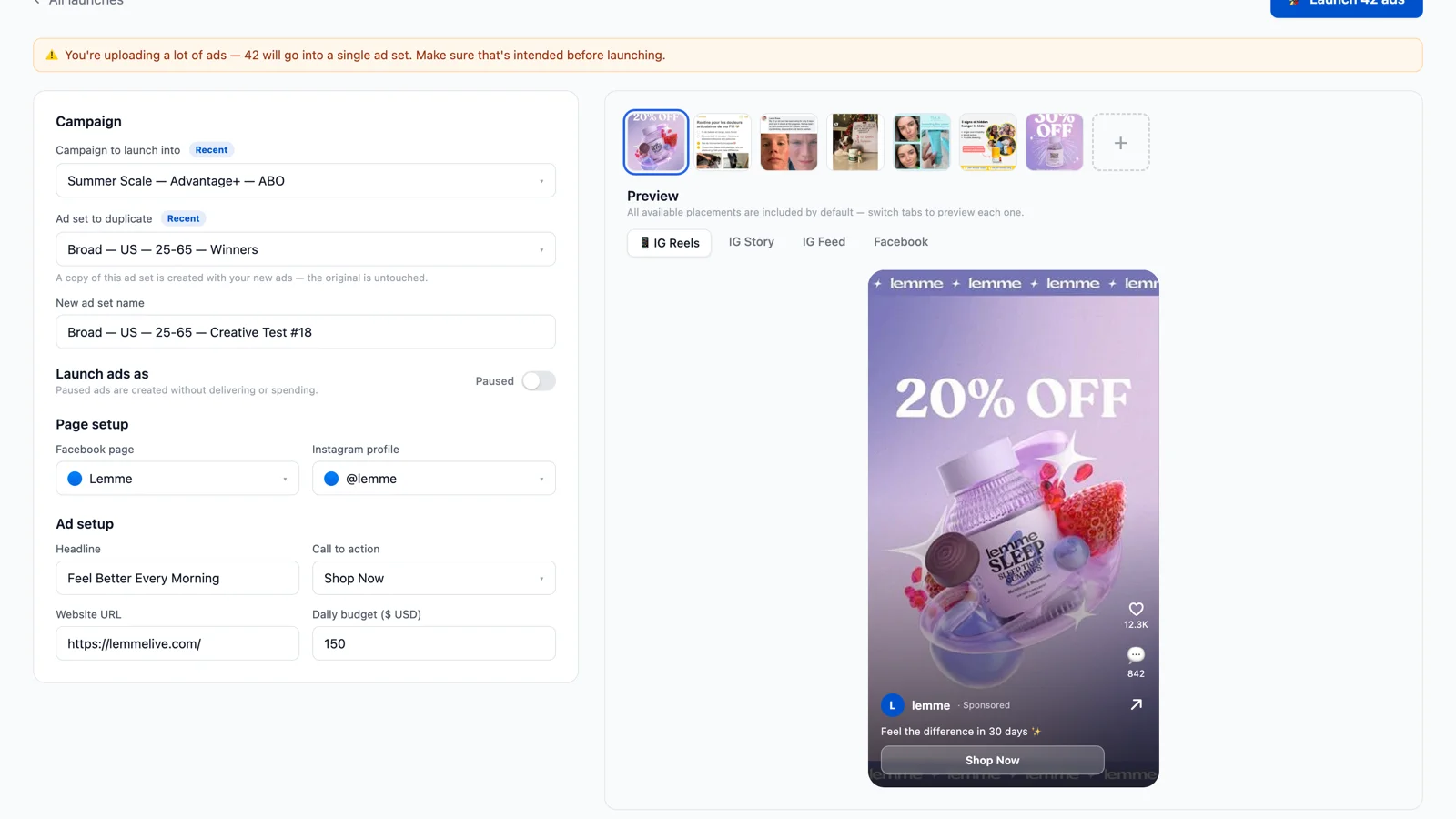
Bulk Ad Launcher for Meta: Launch 100 Facebook Ads in One Click
Skaler's new Bulk Ad Launcher takes you from creatives to live Facebook ads in minutes — drag and drop up to 100 files, duplicate a winning ad set, and launch with copy, budgets, and tracking auto-filled.