
Creative Fatigue in 2026: How Fast Meta Ads Actually Die
Data from 2.9M Meta ads launched in 2025-2026 shows the median creative dies in 3 days. Here's how fast ads really fatigue, why it accelerated, and what fatigue-resistant brands do differently.

 Follow on LinkedIn
The median Meta ad in 2026 lives 3 days. The top 5% live past 38. We pulled 2.9M ads to figure out what separates them, and what to do about it.
TL;DR: A look at 2.9 million inactive Meta ads launched since January 2025 shows the median creative dies in 3 days, 75% of ads are killed within 8 days, and only the top 5% make it past 38 days. High-reach winners run 5-6x longer than the median. The pattern isn't random: ads that survive share specific traits (singular hooks, recurring formats, hook-level iteration) that you can copy. Below: the data, why fatigue accelerated under Meta's Andromeda algorithm, and the refresh cadence that actually keeps ROAS stable in 2026.
If you've felt like Meta ads die faster in 2026 than they used to, you're right, and the data is uglier than the soft-launch posts make it sound. Across 2.9 million inactive Facebook and Instagram ads launched in 2025 and 2026, the median ad lasted 3 days before being killed. The 75th percentile? 8 days. Even the brands shipping winning creative don't escape: the top-reach ads (>500K EU impressions) had a 17-day median lifespan, and only their top 10% ran past 100 days.
This post is the data, what it means for performance marketers, and the operating model the brands still scaling on Meta have all converged on.
What is creative fatigue on Meta in 2026?
Creative fatigue is performance decay caused by the same audience seeing the same ad too many times. In 2026, the symptoms appear in this order: hook rate drops, then CTR slides, then CPM inflates, and finally CPA spikes and ROAS collapses. By the time ROAS visibly drops, you've usually been losing money for 3 to 5 days, because the earlier signals were already there and nobody was looking.
The trick part is that fatigue used to be cleanly signalled by frequency above 3, and that's no longer reliable. Per Meta's late-2025 advertiser guidance, performance now degrades through declining conversion efficiency more than through CTR alone, which means the metric most teams watch (CTR) is the second or third domino, not the first.
How fast do Meta ads actually die in 2026?
Across 2.9M inactive Meta ads launched between January 2025 and April 2026, the median ad ran 3 days. 75% of ads were dead within 8 days. Only 10% survived past 22 days, and only 5% past 38. This isn't a "Meta is broken" stat, it's the natural shape of high-volume creative testing under an AI-driven delivery system that concentrates spend on whatever signals well, then exhausts that audience fast.
Here's the full distribution from the dataset:
| Percentile | Days the ad ran | What it means |
|---|---|---|
| p25 | 2 days | Test killed in the first 48 hours |
| p50 (median) | 3 days | Half of all launched ads die in under 72 hours |
| p75 | 8 days | Most "working" ads only get a week |
| p90 | 22 days | The top 10% reach the classic 3-week window |
| p95 | 38 days | The top 5% break the 5-week ceiling |
| Mean | 9.8 days | Skewed by the long-tail evergreens |
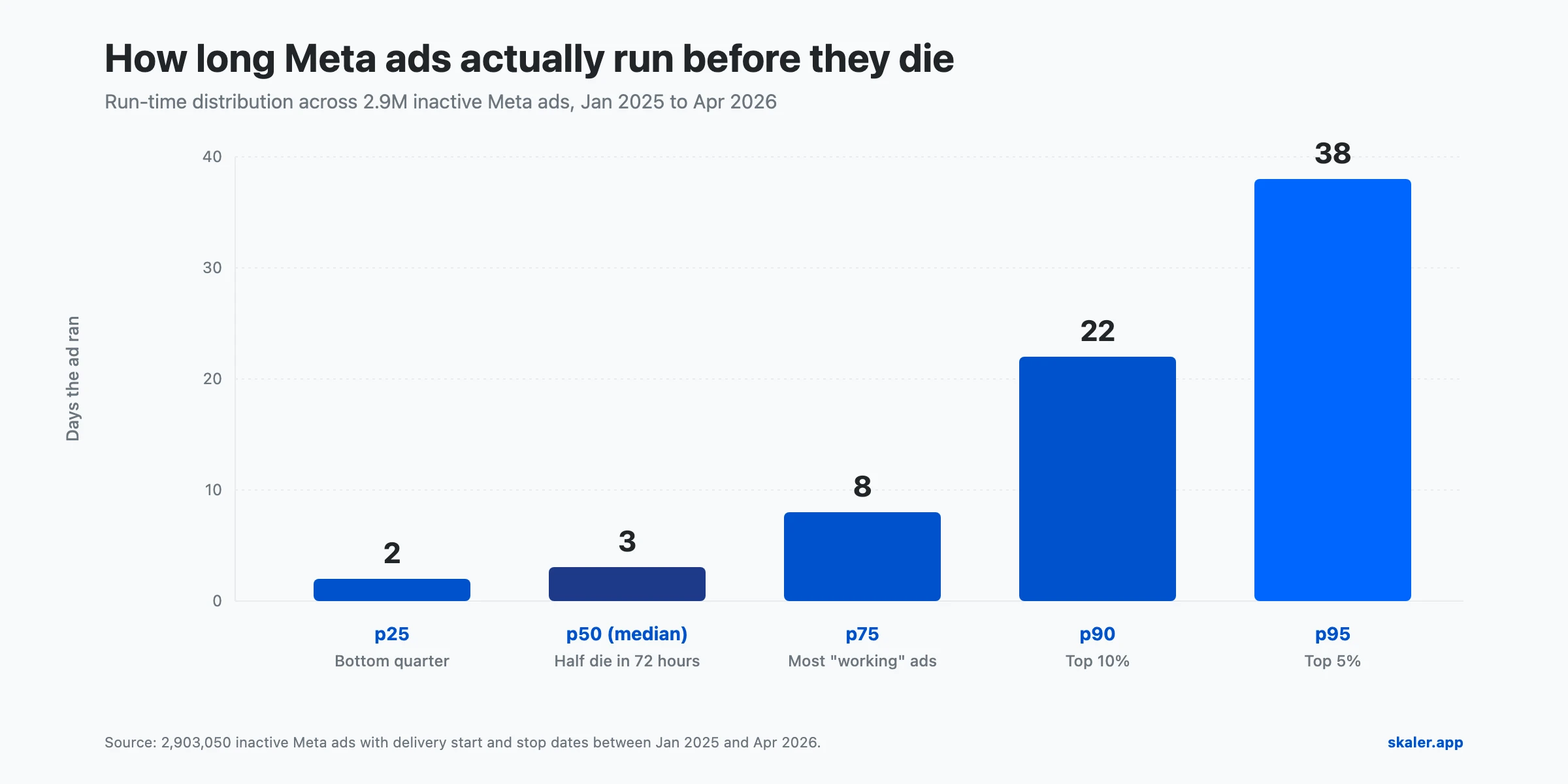
A 3-day median sounds dramatic until you remember most ads launched are tests, and most tests fail fast. The more interesting cut is what changes when you filter to ads that actually scaled.
Filter to ads with 500K+ EU impressions (a rough proxy for "Meta gave this real spend"), and the lifespan multiplies:
| Bucket | Median days run | p75 | p90 | p95 |
|---|---|---|---|---|
| All inactive ads | 3 | 8 | 22 | 38 |
| Top-reach (≥500K EU impressions) | 17 | 49 | 101 | 138 |
Translation: the brands that get one ad working extend its life ~5.7x against the population. The "creative half-life of 11 days" benchmark you've seen quoted in 2025 industry analyses (most prominently a Q3 study spanning 240M impressions and 78,612 creatives) is a population number; for top performers, the half-life is closer to 3-4 weeks, and a small minority extend it past two months. That's the band you're trying to land in.
This also matches the practitioner consensus on cold-traffic prospecting (refresh every 2-4 weeks) and the WordStream-cited 2026 frequency benchmarks: typical winners on Meta hit a wall in 2-3 weeks, and brands running $50K+/month per audience compress that to 7-10 days.
What does a fatigue-resistant Meta ad look like?
Fatigue-resistant ads share three traits: a singular, ownable hook (one phrase a reader can quote back), a format that supports repetition without exposure burn (testimonials, comparison, before/after), and a CTA that survives offer changes. They aren't necessarily the most polished or expensive; they're the ones the audience never quite stops paying attention to.
Four currently-active ads from the long-runner cohort. All have been live for 460+ days (over 15 months) at meaningful reach. Look at what they share, not what they don't:
Pattern recognition: a personalized quiz hook (Bears with Benefits, in market 468 days), a problem-framed direct address (Polar Haircare's "Is your man still using box dyes...", 573 days), a benefits-over-time grid (Florna Ménopause, 495 days, 2.25M reach), and a long-form testimonial with concrete time markers (Tori Repa for BetterMe, 604 days). None are "clever" in the awards-show sense. All are narrow: one promise, one viewer, one reason to keep scrolling.
The thing these ads aren't doing: trying to be everything for everyone. The WARC 2025 creative effectiveness research found ads optimised purely for short-term performance underperform by up to 40% over longer horizons compared to campaigns built around multiple rotating creative ideas. The long-runners above don't violate that finding; they're the anchor in a wider rotation. Their job is durability, not novelty, while fresh tests do the discovery.
Which industries fatigue fastest, and which give you the most runway?
Among real-product categories, vitamins/supplements ads have the longest median runtime (7 days), followed by software (6 days), product/service brands (5 days), and clothing (5 days). The fastest-fatiguing categories are books, education websites, and internet marketing services, all with 2-day medians, plus app pages at 3 days. The pattern: high-consideration verticals with reusable benefit narratives outlast novelty-led or impulse-driven ones.
Median run-time for inactive ads, top categories by volume in 2025-2026:
| Category | Median days run | p75 | p90 |
|---|---|---|---|
| Vitamins/supplements | 7 | 19 | 45 |
| Software | 6 | 18 | 36 |
| Product/service | 5 | 14 | 31 |
| Clothing (Brand) | 5 | 12 | 25 |
| Health Food Store | 5 | 10 | 20 |
| Health/beauty | 4 | 11 | 30 |
| Health & wellness website | 3 | 9 | 22 |
| App page | 3 | 4 | 15 |
| Entertainment website | 3 | 6 | 10 |
| Education website | 2 | 6 | 16 |
| Internet Marketing Service | 2 | 2 | 3 |
| Book | 2 | 3 | 7 |
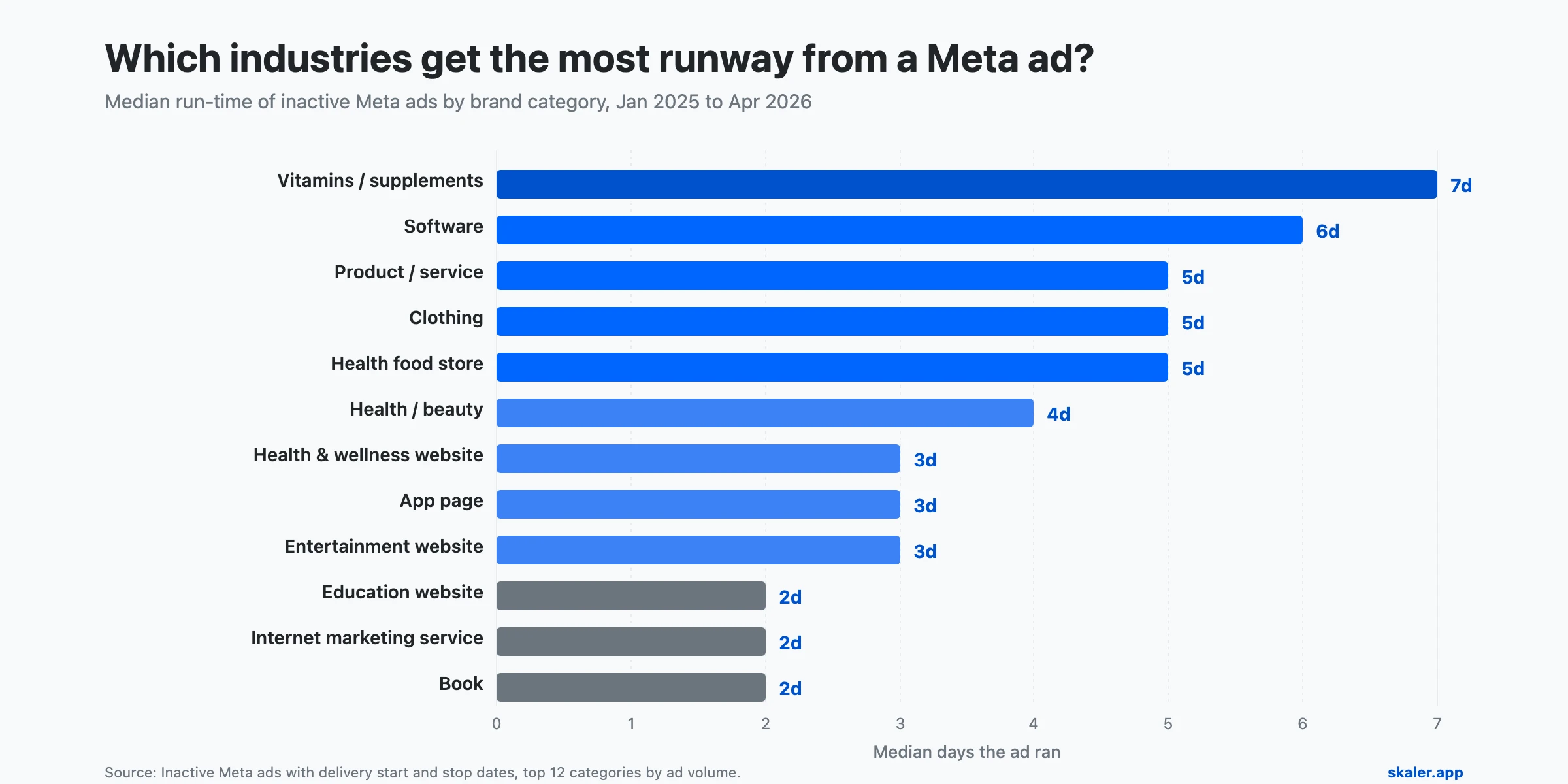
If you're in supplements, software, or DTC apparel, you have more runway than the average post implies. If you're in apps, education, or info-product affiliate, you're operating on a 2-3 day creative cycle whether you planned for it or not, and your production system needs to match.
Why creative fatigue accelerated in 2026
Three structural shifts compressed the fatigue window in 2026: Meta's Andromeda ranking system uses creative as a primary delivery signal, Advantage+ concentrates spend on a narrower set of high-converting users, and consumer ad exposure is at a record high. Net effect: ads that used to run 6-8 weeks two years ago now hit a wall in 2-3, and high-spend campaigns into narrow audiences fatigue in 7-10 days.
The mechanics under the hood:
- Creative is the new targeting. Under Andromeda and broad-targeting Advantage+ campaigns, the platform decides who sees your ad based primarily on the creative itself, not on interest stacks. That means once a creative stops resonating with the cluster of users it was being delivered to, Meta has no soft alternative; it just stops finding new pockets within your broad audience and the ad starves.
- Delivery concentration. Meta's auction now serves 70-80% of impressions to the cluster most likely to convert in the first 7-10 days, which compresses the time-to-saturation. Nielsen's 2025 Digital Ad Effectiveness report found ads lose impact up to 35% sooner under algorithm-driven delivery than under structured manual targeting.
- Exposure ceiling. The IAB's 2025 UK Digital Ad Spend Report puts daily ad exposure per person above 5,000 impressions across platforms. People recognise and tune out repeated creative faster than ever, even when the creative is high quality.
- Conversion likelihood decay. Meta's own research, cited across multiple practitioner syntheses in 2026, shows conversion likelihood drops roughly 45% by the fourth repeated exposure. Frequency 3 in a 7-day window is no longer a soft warning, it's already in the danger zone.
🔍 Skaler ranks every creative in your Meta account by spend, ROAS, and creative fatigue automatically, so you spot decay before ROAS drops, not after. Try it free →
How to detect creative fatigue before ROAS drops
The leading indicators always show up days before ROAS does. In rough order of how early they catch fatigue:
- Hook rate decline. 3-second video view rate dropping below 25%, or 20% off the creative's first-week baseline, fires 2-3 days before CPA spikes. Hook rate is the cleanest early signal because it isolates the part of the ad that fatigues fastest.
- CTR decay over 5+ consecutive days. Single-day CTR drops are noise. A rolling 3-day average down 15%+ from the creative's first-week baseline is signal. 20%+ over two weeks is confirmed fatigue, no need to wait for confirmation from CPA.
- Frequency above 2.5 in a 7-day window (prospecting). This used to be the canonical signal and it's still useful, but it's now a co-signal, not a sole one. Ads can fatigue while frequency still looks acceptable on paper, especially under Advantage+ where Meta is concentrating delivery on a narrow cluster.
- CPM rising while CTR falls. When CPM inflates 15%+ week-over-week and CTR is sliding, you're paying more for fewer engagements. That double-hit shows up before CPA does and is one of the cleanest visual diagnostic patterns at the ad level.
- Creative age past 21 days at meaningful spend. Preventive, not reactive. If a creative has been running for 3+ weeks at $1K+/day on cold traffic, treat it as fatigued by default and have a replacement ready, regardless of what the metrics say today.
The mistake most teams make is watching ROAS as the primary signal. ROAS is the last metric to crack. By the time it drops 20%, you've already wasted 3-5 days of budget on an audience that stopped caring.
How fast should you refresh creative on Meta in 2026?
Refresh cadence should match your spend level and audience size. The current consensus across Meta's own guidance and 2026 practitioner data: $20K+/month spenders refresh every 7-14 days, $5K-$20K/month every 10-14 days, and sub-$5K/month every 14-21 days. Higher spend exhausts the audience faster, so the cadence has to compress with the budget.
| Monthly spend | Audience size | Refresh cadence |
|---|---|---|
| Over $50K | 5M+ | Every 5-7 days |
| $20K-$50K | 2M-5M | Every 7-10 days |
| $5K-$20K | 500K-2M | Every 10-14 days |
| Under $5K | <500K | Every 14-21 days |
The teams hitting these cadences without burning out have all converged on the same operating model: a 14-day creative sprint that ships 5-10 new concepts per cycle, plus 2-3 hook variations of every winner. The math reported across multiple 2026 practitioner accounts: roughly 70% losers, 20% average, 10% scaling-grade. That's not a sign your team is bad; it's the expected hit rate. Volume is the system.
A practical sequence that works at $20K-$50K/month:
- Week 1: launch 5 new concepts (3 statics, 2 video).
- Week 2: cull the bottom 3, ship 3 hook variations of the survivors.
- Week 3: cull again, ship 3 angle variations of the top 1-2.
- Week 4: retire the original, promote the variant winner, brief the next 5 concepts.
The cycle is the work. The "perfect ad" is not.
What fatigue-resistant brands do differently
The brands still scaling on Meta in 2026 ship more ads, faster, with tighter formats. They run 30-40 active variations across an account, treat each ad as one of many bets, and refresh hooks (not whole concepts) the moment hook rate decays. Hooks fatigue first; the rest of the ad usually has more life left.
A snapshot of accounts shipping at velocity in the last 90 days, all currently active:
Four very different brands, same playbook: AG1's Hugh Jackman testimonial format ("I tell my neighbours, you don't need pills for this, powders for that"), Hume Health's direct comparison hook against a competitor wearable, Dr. Squatch's UGC sale-discount unit ("One less thing to worry about in 2026"), and Saily's punchy benefit-first image ("Wi-Fi hunting is the best cardio"). Each brand ships hundreds to thousands of variants per quarter and rotates relentlessly. None of these specific ads existed 60 days ago.
Three habits worth copying:
- Iterate hooks before refreshing concepts. A 30-second video doesn't need to be reshot when it fatigues. Most of the time, swapping the first 3 seconds restores 70-80% of the original CTR for a third of the production time. Build a hook library, not a video library.
- Run a creative bank, not a creative folder. Top-performing accounts keep 25-50 ads ready to launch at any moment. The bench matters more than the starter; when fatigue hits, you don't want to be writing a brief, you want to be queueing a launch.
- Diversify formats simultaneously. Meta's own Creative Best Practices guide reports campaigns using 3+ ad formats see 32% lower cost per result on average. Statics, short videos, carousels, and 9:16 reels each tap a different attention pattern; running them in parallel extends the total lifespan of your creative library.
Frequently Asked Questions
How long does a Facebook ad last before it fatigues? Across 2.9M ads launched in 2025-2026, the median creative ran 3 days and 75% were dead in 8. Top-performing ads (>500K EU impressions) lasted 17 days at the median, with the top 10% running past 100 days. Practical refresh cadence on Meta in 2026: every 2-3 weeks for cold prospecting, faster for high-spend accounts.
What's the earliest sign of creative fatigue on Meta? Hook rate decline. A 3-second view rate dropping below 25%, or 20% off the creative's first-week baseline, typically appears 2-3 days before CPA spikes. CTR is the second domino, frequency is third, and ROAS is last. Watching ROAS only means you find out 3-5 days late.
How often should I refresh Facebook ad creative in 2026? Match cadence to spend: under $5K/month every 14-21 days, $5K-$20K every 10-14 days, $20K-$50K every 7-10 days, over $50K every 5-7 days. High spend compresses the timeline because it exhausts the audience faster. Use frequency above 2.5 in a 7-day window plus CTR decline of 15%+ as a forcing function.
Is creative fatigue worse on Meta or TikTok in 2026? TikTok is sharply faster: top-spend videos can fatigue in 3-5 days vs Meta's 7-21 day window. The reason is platform behaviour: TikTok's algorithm serves aggressively to engaged users and the platform expects daily creative rotation. Plan to ship 3-5 new ad versions per ad group per week on TikTok versus 5-10 every two weeks on Meta.
Why has creative fatigue accelerated in the last two years? Three reasons: Meta's Andromeda ranking system uses creative as a primary delivery signal (so stale creative loses targeting precision, not just engagement), Advantage+ concentrates spend on a narrow cluster of converters, and daily consumer ad exposure is now above 5,000 per person. Ads that ran 6-8 weeks in 2024 now hit a wall in 2-3.
The takeaway
In 2026, creative is not the deliverable, the system is. The brands still scaling on Meta have stopped trying to find one winning ad and started running a production line that assumes every ad will fatigue, on a known curve, with a known replacement queued up. The 3-day median is brutal if your model is "launch one ad and watch it." It's noise if your model is "launch 10, kill 7, refresh the survivors weekly."
Watch hook rate before ROAS. Refresh hooks before whole concepts. Keep a bench. Match cadence to spend. And ship more, not better.
Stop Catching Fatigue After ROAS Drops
Skaler connects to your Meta ad account, ranks every creative by spend, ROAS, and fatigue signals, then pairs the analytics with an indexed competitor library so you can ship the next ad without leaving the workflow. Spot the decay before CPA spikes; brief the replacement before the survivor fades. Try it free →
Related Resources
- How to Analyze Ad Performance: A Data-Driven Approach
- Ad Creative QA Checklist: 40+ Checks Before You Hit Publish
- Free AI Hook Generator
- 5 Ad Creative Best Practices
- Facebook Ads Not Converting? 15 Reasons Why
- Creative Strategy: Frameworks, Templates, and Examples
- Best Facebook Ad Reporting Tools for 2026
Related Articles
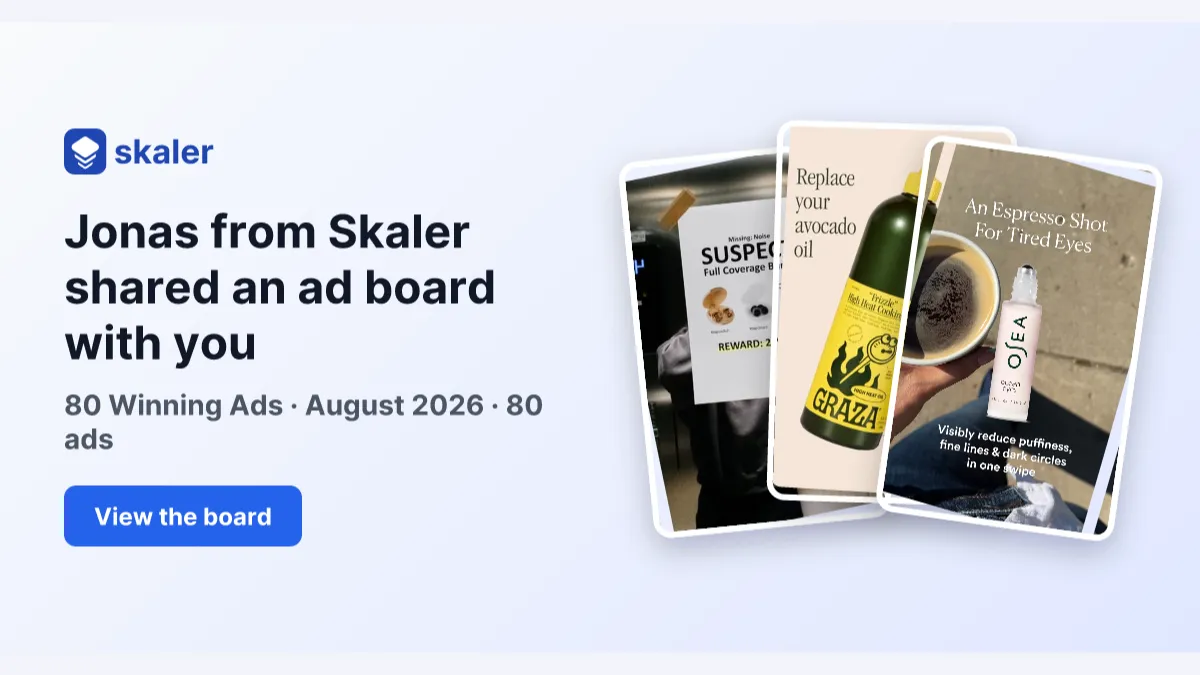
The 80 Most-Saved Meta Ads of August 2026 (Free Swipe File)
We tracked the 80 Meta ads media buyers saved the most this month — from Seed and Loop to AI soap operas running across 9 ad sets. Browse all 80 free, plus the 4 patterns behind them.
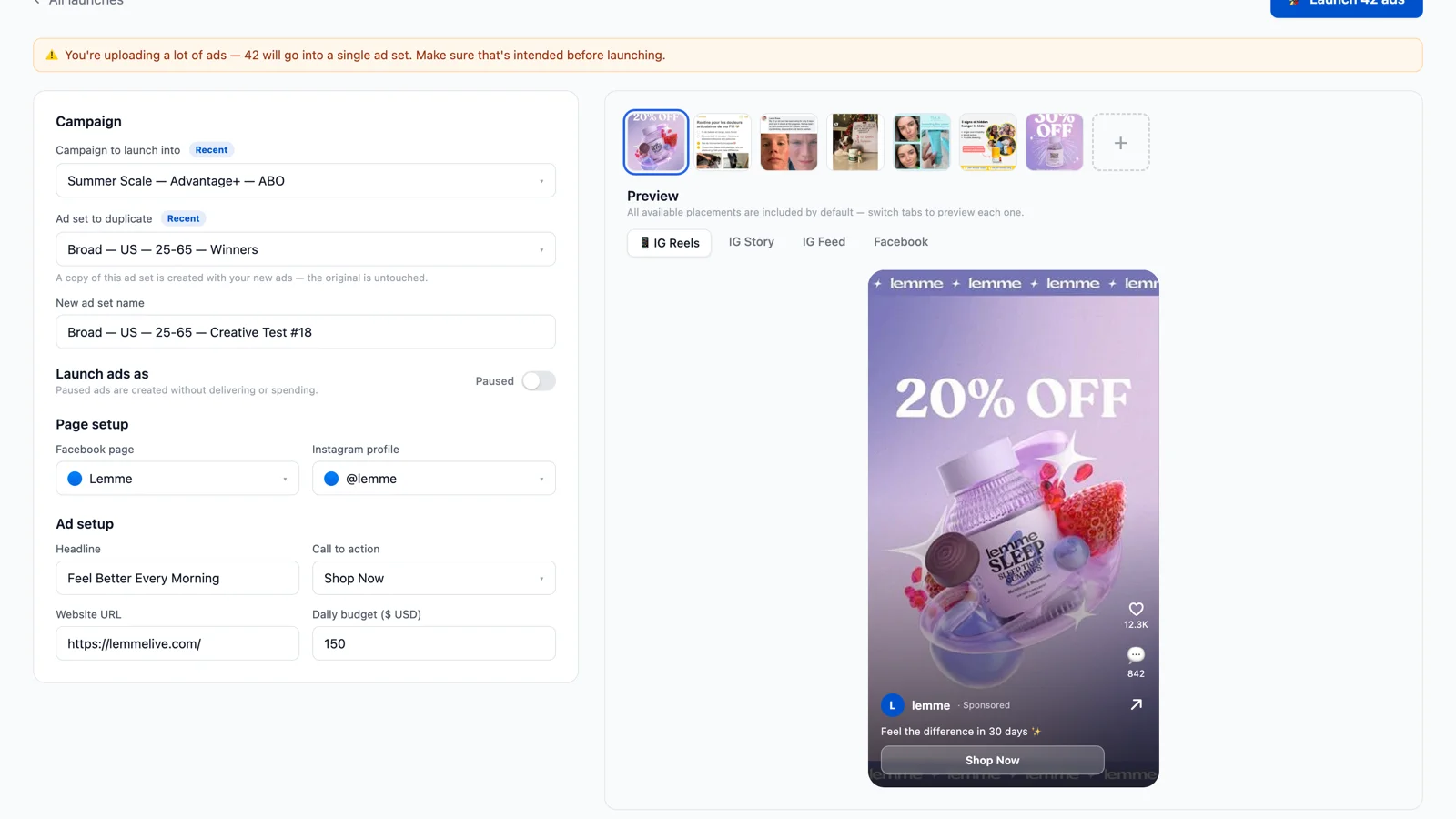
Bulk Ad Launcher for Meta: Launch 100 Facebook Ads in One Click
Skaler's new Bulk Ad Launcher takes you from creatives to live Facebook ads in minutes — drag and drop up to 100 files, duplicate a winning ad set, and launch with copy, budgets, and tracking auto-filled.