
Creative Strategist: The 2026 Guide to the Role, Salary, and AI Tools Reshaping It
What a Creative Strategist actually does, salary ranges in the US and UK, must-have skills, and the AI tools reshaping the role in 2026 — a practical guide for performance marketers.

 Follow on LinkedIn
The hybrid role that bridges data and design — and the AI shift that's reshaping it in 2026.
A Creative Strategist is the performance marketer who decides what your next ad should look like, why it should look that way, and how you'll know it worked. They live between Meta Ads Manager and the creative brief — translating a CTR drop or a ROAS dip into the next round of hooks, scripts, and visuals. The role barely existed five years ago. Today it's the single most in-demand hybrid hire on performance marketing teams, with 400+ open roles on LinkedIn UK alone and salaries climbing fast.
This guide covers what a Creative Strategist actually does day to day, how much they earn in the US and UK, the skills you need to break in, the tools modern strategists use, and the AI shift that's quietly rewriting the job description in 2026.
What is a Creative Strategist?
A Creative Strategist is responsible for the creative side of paid social performance — owning the briefs, hooks, formats, and testing roadmap for ads on Meta, TikTok, YouTube, and increasingly LinkedIn. Their job is to bridge two skill sets that historically lived in different rooms:
- The data side: reading ad account performance (ROAS, CPA, CTR, hook rate, hold rate, frequency), pulling competitor research, and identifying which creative angles are scaling and which are fatigued.
- The creative side: turning that data into specific, briefable concepts — scripts, scenes, on-screen text, visual references, and CTA hierarchies — that designers, video editors, UGC creators, and copywriters can execute.
Until ~2021, this work was split between a media buyer (data) and a creative director or copywriter (execution). The split broke as iOS 14.5, the death of granular targeting, and the rise of TikTok-native ads made creative the new targeting. The Creative Strategist role emerged to own that single most important performance lever end-to-end.
The simplest definition: a Creative Strategist is the person who decides — with data, not vibes — what your next 30 ads should test.
What does a Creative Strategist actually do?
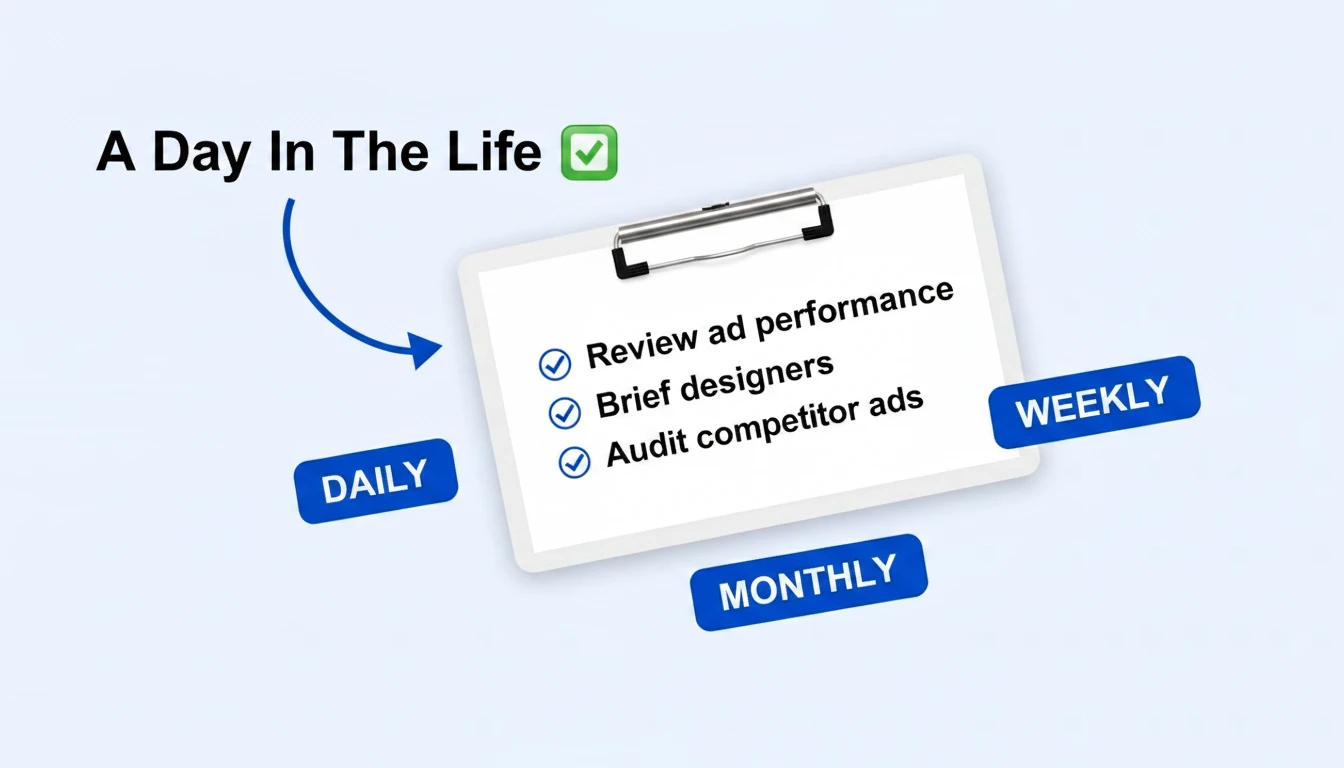
The day-to-day depends heavily on company size — at a 5-person DTC brand the Creative Strategist might also be doing the media buying and editing. At a 50-person scale-up they'll be coordinating designers, UGC creators, and an in-house video team. Either way, the work splits into three cadences.
Daily (about 25% of time)
- Performance review: open Meta Ads Manager (and TikTok Ads Manager / Google Analytics) and scan the last 24–72h. Flag ads that are over- or under-pacing CPA targets, note hook rates and hold rates on new tests, look for fatigue signals (rising frequency, falling CTR, climbing CPM).
- Competitor monitoring: scroll the Meta Ad Library and TikTok Creative Center for new entrants in your category. Save anything novel — a new hook angle, a new format, a new offer construct — into a swipe file.
- Brief execution: hand off the day's creative briefs to designers, editors, copywriters, or external UGC creators. Answer questions, unblock production, approve cuts.
- Media buyer sync: 10–15 minute standup with the buyer on what creative is winning, what's about to be killed, and what's queued for launch.
Weekly
- Performance retrospective: pick the top 3 winners and top 3 losers from the last week. Diagnose why they performed — hook, format, offer, audience. Document it so the next round of briefs can replicate the pattern.
- Brainstorm and ideation: generate 10–20 net-new ad concepts for the next sprint. Source from competitor swipes, customer reviews, support tickets, and emerging cultural moments.
- Brief writing: turn approved concepts into production-ready briefs (script + storyboard + format spec + reference ads + brand guardrails).
- Audience research: 30–60 minutes deep-reading reviews on Amazon, Trustpilot, and Reddit. The exact phrases customers use about your category are the highest-converting hooks you'll never write at a desk.
Monthly
- Strategy doc update: refresh the creative strategy document — current testing themes, which messaging pillars are winning, which formats are exhausted, what to test next month.
- Library audit: review every ad live in the account. Kill assets past their fatigue point (typically 2–4 weeks at scale, sometimes faster). Identify gaps: are there formats (UGC, static, demo, before/after) you haven't tested in 60+ days?
- Reporting: present a creative scorecard to the wider growth team — what was tested, what won, what's next, with concrete CPA / ROAS / hook rate impact.
🎯 Skaler acts like an always-on AI Creative Strategist — pulling competitor ads, scoring your own creatives, and surfacing the next tests automatically. Try it free →
Skills you need to be a Creative Strategist
Every job description reads slightly differently, but the high-leverage skills cluster into four buckets:
1. Reading paid social like a native. You need fluency in Meta Ads Manager, TikTok Ads Manager, and ideally one analytics layer (GA4, Triple Whale, Northbeam, or Hyros — see our Hyros integration guide if your team uses it). You're looking at hook rate, hold rate, thumb-stop rate, CPA, ROAS, and frequency every single day. If you can't pull a creative report in Meta and tell a story from it inside 10 minutes, you're not ready.
2. Creative writing, with constraints. You're writing 8-second hooks, 30-second scripts, and 6-word headline variants — not novels. Strong Creative Strategists are obsessive about specifics: which exact word changes a CTR by 30 basis points, why "your skin" beats "skin" in a headline, when a benefit beats a feature. You don't need to be a copywriter, but you need to brief one well.
3. Visual and format literacy. You should be able to look at a brand's existing ads, identify the gap (e.g. "we have zero before/after creatives in a category where every winner is a before/after"), and brief the format with enough specificity that the editor doesn't come back with three rounds of questions. This includes safe zones, aspect ratios, and platform-native conventions — see our full ad creative QA checklist.
4. Project management. Most Creative Strategists are managing 2–8 contributors at any time — designers, editors, UGC creators, voiceover talent, external agencies. Briefs go out, drafts come back, feedback loops compress. The strategists who scale are the ones who treat creative production like a manufacturing line, not a vibe session.
What's NOT required (despite what job ads say)
A formal design or marketing degree. A specific certification (Meta's "Certified Creative Strategy Professional" is nice-to-have, not required). Years of agency experience. The fastest-growing path into the role is from a junior media buyer or a UGC creator who learned to read data — both routes are well-trodden in 2026.
Creative Strategist salary in 2026
Salaries vary wildly by geography, company stage, and whether you're in-house or at an agency. Rough benchmarks for full-time, permanent roles:
- United States — $75K–$130K base for in-house roles at DTC and SaaS brands. NYC and SF skew $90K–$140K. Senior / Lead Creative Strategists at scale-ups regularly hit $150K–$180K total comp with equity. Netflix, Meta, and other big-tech in-house creative strategist roles can clear $200K base.
- United Kingdom — £55K–£80K base in London (London carries a ~28% premium over the rest of the UK, per Glassdoor). £45K–£65K outside London. Day rates for contractors run £350–£600.
- EU — €50K–€85K in the major DTC hubs (Berlin, Amsterdam, Stockholm). Slightly lower in southern Europe.
- Remote at US-payroll agencies — frequently $70K–$110K for mid-level, even from cheaper geographies.
The ceiling is rising fast. What was a £55K role in 2022 is a £75K role today, and the senior tier (Head of Creative Strategy, VP Creative) is opening up at brands spending $1M+/month on paid social.
How to become a Creative Strategist
There's no single path, but the four most common routes look like this:
- Junior media buyer → Creative Strategist. You already know the data side. Start writing the briefs you wish your buyer's marketing team gave you. Within 6–12 months you'll have a portfolio of campaigns where you can show "I briefed it, here's the result."
- UGC creator → Creative Strategist. You already know what hooks land. Start documenting why — keep a swipe file, learn to read Ads Manager, and build a portfolio of "this hook → this metric" examples.
- Copywriter / designer → Creative Strategist. You already know the craft. Learn the data layer — take Meta Blueprint courses, get hands-on access to a real ad account (even a side project), and start running your own tests.
- Cold start (career switcher). Build a public portfolio. Pick 2–3 brands you love, audit their ads in the Meta Ad Library, and write a free creative strategy brief for each. Post the briefs on LinkedIn. Founders DM you. (This is how 30% of the strategists I know got hired.)
In every path, the unifying thread is a public portfolio of "here's what I'd test, and why." Not finished campaigns — strategy documents. The job is a thinking job, so prove the thinking.
What a great creative strategist's output looks like
The output of a Creative Strategist isn't a single ad — it's a portfolio of tests built around a thesis. A strong week might ship a UGC testimonial, a comparison ad, a problem-aware story-led video, and a benefit-stacked product shot, all targeting the same audience with different angles. Here are four currently-running ads from different brands that each represent a distinct creative-strategist play:
Look at what's happening across that row. Hume Health opens with a fear-led hook ("Imagine catching a heart attack two weeks before it happens") that bundles testimonial proof. Frøya Organics positions a natural product directly against a category benchmark ("This is how a dash of arnica ended Botox") — classic us-vs-them angle. IM8 leads with a tangible 30-day promise. Elavate runs a long-form personal story for an over-40 audience.
A Creative Strategist didn't just commission those ads. They identified the angle, briefed the script structure, and slotted each one into a testing matrix — so the next round of tests can scale the winning angle and kill the rest.
And four more, this time across formats
Here's a second row showing format diversity — a real-estate-style image ad, a comparison/us-vs-them video, a story-led testimonial, and a product showcase grid. Same skill set, different toolbox:
Notice how across all eight ads, none repeat the same hook construction. That's the signature of strategy: deliberate variety, anchored in performance data, with a clear hypothesis behind each variant.
How AI is reshaping the Creative Strategist role in 2026
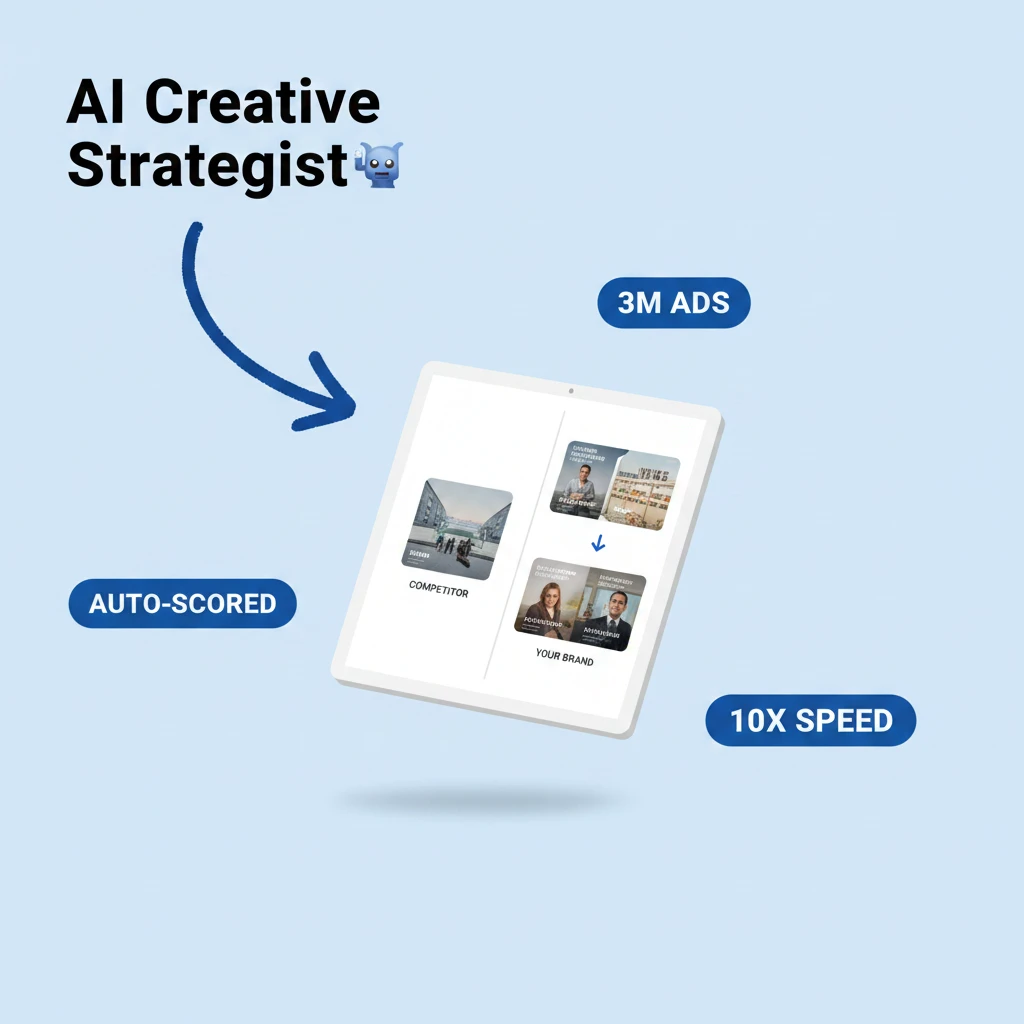
The version of the Creative Strategist role that emerged in 2021–2023 was built around a manual, ad-spy + Notion + Google Doc workflow. You'd scroll the Meta Ad Library for hours, screenshot interesting ads into a swipe file, write briefs in a doc, hand them off to a video editor, and wait.
In 2026 that workflow is breaking down for three reasons.
1. The volume of ads to test has 5x'd. Top DTC brands now ship 50–200 net-new creatives a month. The bottleneck isn't ideas — it's brief throughput. AI brief generation, AI script drafting, and AI variant generation cut that from 8 hours per concept to under 30 minutes.
2. The competitive moat is now in what you test, not how fast you produce. When everyone has the same AI tools to produce ads, the differentiator is the strategy layer: which competitor angles are scaling? Which of your past winners can you remix? Which hook formats are working right now in your category? AI tools that surface and score this — like Skaler — are becoming non-negotiable.
3. Ad-spy is being replaced by ad-intelligence. Old workflow: open the Meta Ad Library, scroll, screenshot. New workflow: search 3M+ ads by keyword, brand, ad type, format, or semantic concept ("show me POV selfie ads in the supplement category"), filter by performance score, and clone the winners directly into your brand's visual style. This is what people increasingly mean when they say "AI Creative Strategist" — a system that does the research, scoring, and first-draft creative work that used to fill the strategist's whole week.
The strategists who'll thrive are the ones who treat AI as a research analyst and a junior designer that never sleeps — and reinvest the saved time in the parts of the job AI still can't do: synthesis, taste, customer empathy, and the ability to look at 200 winning ads and say "the angle that's about to break out is this one."
Creative Strategist vs. Creative Director vs. Content Strategist
These three titles overlap enough to confuse hiring managers. The clean distinctions:
- Creative Strategist owns what gets made and why, specifically for paid media performance. Their KPIs are CPA, ROAS, hook rate, hold rate. Output: briefs and a testing roadmap.
- Creative Director owns how it looks and feels — the visual language, brand consistency, and craft quality across creative work. Their KPIs are brand health and qualitative judgment. Output: art direction and final approval on look and feel.
- Content Strategist owns organic content — blog calendars, SEO, owned channels, long-form distribution. Their KPIs are organic traffic, time on page, engagement. Output: editorial calendars and content briefs for non-paid channels.
The simplest test: who writes the brief for next week's Meta campaign? That's the Creative Strategist. Who signs off on the final shade of blue in the logo treatment? That's the Creative Director. Who plans the Q3 blog calendar? That's the Content Strategist.
Resume Worded reports a 77% skill overlap between Creative Strategist and Creative Director — which is why on small teams the same person often does both. As teams scale past 10–15 people, the roles split.
The Creative Strategist's modern toolkit
A short, opinionated list of what a working Creative Strategist actually has open in their browser:
- Ads Manager (Meta and TikTok) — the source of truth for what's working in your own account.
- Ad-intelligence platform — Skaler, or one of the Foreplay alternatives / MagicBrief alternatives — for competitor research, swipe files, and pattern-spotting.
- Analytics layer — GA4, Triple Whale, Northbeam, or Hyros for blended ROAS and post-iOS attribution.
- Brief tooling — Notion, Frame.io, or built-in tools in your ad-intelligence platform.
- AI hook and script generation — for first-draft script variants. Our free hook generator is a good starting point.
- Mockup and preview tools — to see how a brief will render in the actual placement before production. The free ad mockup generator handles this in the browser.
- QA checklist — every ad runs through a pre-launch review (we publish ours as the free ad QA checklist).
The trend across all of these: tools that used to require switching between 4–6 tabs are now consolidating into single platforms with AI built in. The Creative Strategist of 2026 is increasingly working from one tool that does spy, analyze, and create — instead of duct-taping six tools together.
Frequently asked questions
What is a Creative Strategist? A Creative Strategist is a performance marketing role responsible for the creative side of paid social — using data from Meta, TikTok, and other ad platforms to brief, test, and iterate ads that drive ROAS. They sit between media buyers and creative producers (designers, editors, UGC creators).
What does a Creative Strategist do day to day? They review ad performance, monitor competitor ads, brief designers and copywriters, run weekly creative retrospectives, and update the creative strategy document monthly. About 25% of the day is performance review, the rest splits between research, ideation, brief writing, and unblocking production.
How much does a Creative Strategist make? In 2026, US Creative Strategists earn $75K–$130K base, with senior roles hitting $150K–$200K total comp. UK strategists earn £55K–£80K in London and £45K–£65K outside. Contractors charge $400–$800 per day.
How do you become a Creative Strategist with no experience? Build a public portfolio of strategy briefs. Pick 2–3 brands, audit their ads in the Meta Ad Library, write a free creative strategy brief for each, and post on LinkedIn. Most entry-level Creative Strategists either come from media buying, UGC creation, or copywriting — pick whichever side you're closer to and add the other.
Do you need a degree to become a Creative Strategist? No. Most hiring managers prioritize a portfolio of campaigns, demonstrated data fluency, and platform expertise over academic credentials. A marketing or comms degree is helpful but not required.
Is Creative Strategist a stressful job? The deadlines are real (creative ships every week) and the role carries direct accountability for ROAS, but most strategists rate the role highly because the impact is visible. You ship an ad on Monday, it's spending $20K/day by Friday — few roles get that kind of feedback loop.
What's the difference between a Creative Strategist and a Creative Director? A Creative Strategist owns what gets made and why, accountable to performance metrics. A Creative Director owns how it looks and feels, accountable to brand standards and craft. Small teams often combine the two; teams over 15 people usually split them.
The takeaway
The Creative Strategist is the highest-leverage hire on a modern performance marketing team. The role exists because creative is now the targeting — and the brands that systematically test the right ideas, fast, win their categories.
Whether you're hiring one, becoming one, or working with one, the same principle applies: the job is a thinking and testing job, not a producing job. Tooling that gives Creative Strategists more time to think and faster feedback loops on what they ship is the single biggest unlock available to growth teams in 2026.
Want to think and test like a top-tier Creative Strategist?
Skaler was built for this exact role — the AI-powered Creative Strategist that lives next to your ad account.
Skaler searches 3M+ competitor ads, scores your own creatives by performance, clones winning formats into your brand style, and surfaces the next tests automatically — so you spend your time on strategy instead of swiping. Free to start →
Related Articles
The 80 Most-Saved Meta Ads of August 2026 (Free Swipe File)
We tracked the 80 Meta ads media buyers saved the most this month — from Seed and Loop to AI soap operas running across 9 ad sets. Browse all 80 free, plus the 4 patterns behind them.
Bulk Ad Launcher for Meta: Launch 100 Facebook Ads in One Click
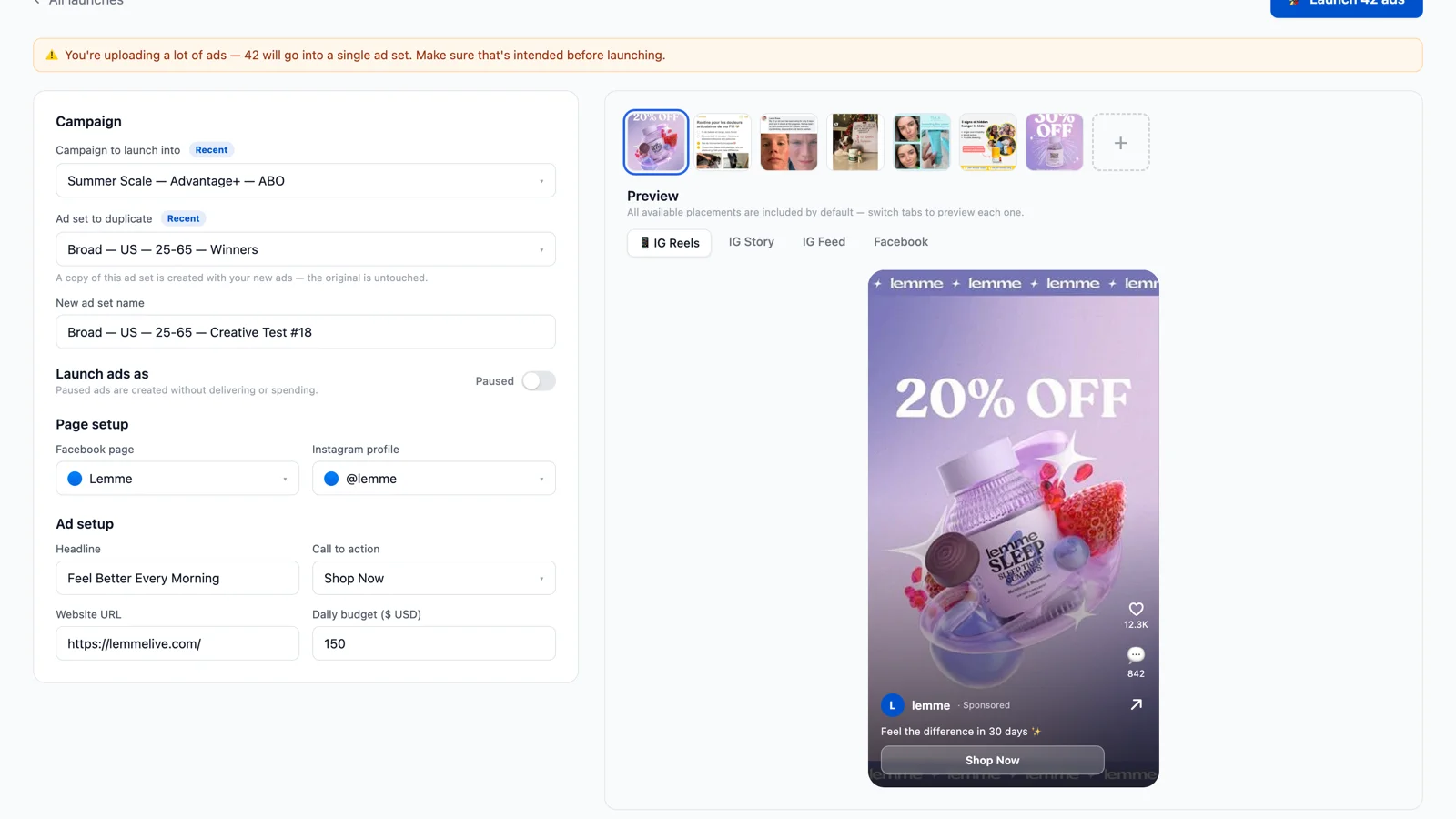
Skaler's new Bulk Ad Launcher takes you from creatives to live Facebook ads in minutes — drag and drop up to 100 files, duplicate a winning ad set, and launch with copy, budgets, and tracking auto-filled.