
Creative Strategy: Frameworks, Templates, and Advertising Examples for Performance Teams (2025)
A practical guide to creative strategy in advertising—what it is, how to build a framework, what to measure, and examples for Meta and TikTok.

 Follow on LinkedIn
Creative strategy is the plan behind your ads: the audience insight you’re leaning on, the message you’re trying to land, the proof you’ll use, and the formats you’ll ship—so your team can produce creative that reliably drives business outcomes.
If you work in-house (performance marketing, design, editing, or media buying), creative strategy matters because paid platforms increasingly reward what people respond to, not what you manually set. The targeting and bidding knobs haven’t disappeared, but they’ve become less of the day-to-day advantage. The advantage is knowing what to make next—and doing it on a repeatable cycle.
This guide covers:
- A clear definition you can align on internally
- Frameworks that work for performance teams (not just theory)
- Real advertising examples (Meta + TikTok)
- A copy/paste creative strategy template
- A few data-backed patterns from EU/UK spenders to ground the discussion
 Creative strategy connects customer reality to production output — so your team can move fast without guessing.
Table of contents
- What is creative strategy?
- Creative strategy vs brand strategy
- Creative strategy in advertising
- Inside an in-house team
- A simple framework
- What to measure
- Real data from EU/UK spenders
- Creative strategy for Meta
- Creative strategy for TikTok
- Examples
- Template
- Common mistakes
- FAQs
What is creative strategy?
Creative strategy is the blueprint for how your ads communicate to a specific audience to achieve a specific goal. It defines:
- Who you’re talking to (audience + context)
- What you’ll say (message + angle)
- Why anyone should believe you (proof mechanism)
- How you’ll say it (format + structure + tone)
- Where it will live (channels/placements)
- What you’ll test next (iteration rules)
A creative strategy is not a “style guide,” and it’s not just an ad brief. It’s the connective tissue between customer reality and production output—so your team can move fast without guessing.
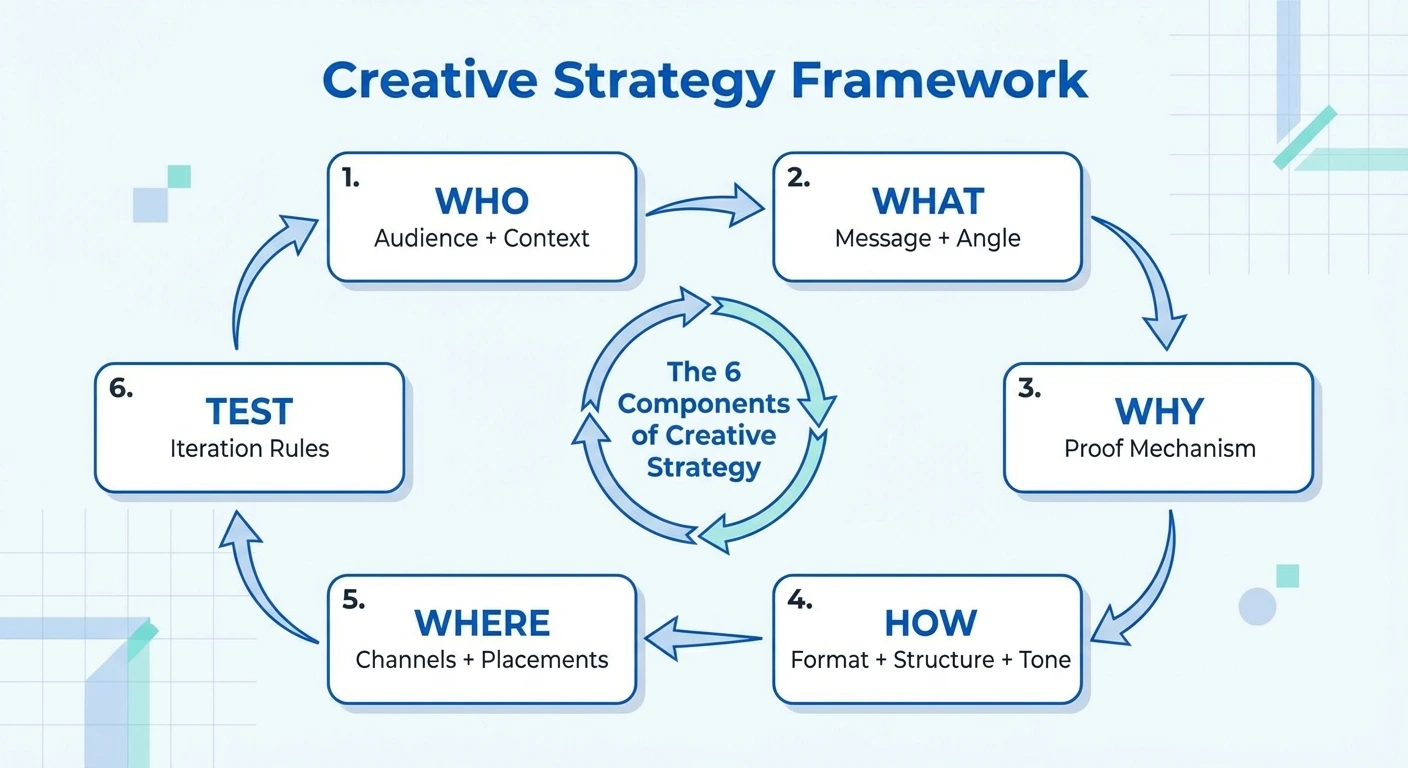 The six components every creative strategy should define.
Creative strategy vs brand strategy
They overlap, but they’re not the same job.
- Brand strategy is long-term: positioning, voice, identity, category story, what you stand for.
- Creative strategy is campaign and performance oriented: the message + proof + format choices that win attention and conversions in a specific channel right now.
A brand can have a strong brand strategy and still lose in paid if the creative strategy doesn’t translate into ads people stop for, click, and buy from.
Creative strategy in advertising (why it became everyone’s job)
Performance teams used to talk about “targeting” and “media buying skill” as the edge. Today, the edge is increasingly about creative systems:
- Platforms keep pushing more automation in targeting and bidding (see Meta’s Advantage+ overview).
- More placements are algorithmic by default.
- More advertisers compete for the same attention.
When your targeting becomes broader and the system does more matching, your creative becomes the signal. Not in a poetic way—literally as the input the system can learn from and distribute.
This is why creative strategy has moved from “nice to have” to a core growth function.
What creative strategy looks like inside an in-house team
Here’s a practical way to split responsibilities so the work actually ships:
- Creative strategist (or performance lead acting as one):
- Owns research inputs, hypotheses, and what to make next
- Defines the message + proof + format selection
- Writes briefs that are specific enough to reduce rework
- Designer / video editor:
- Owns execution quality and variation craft
- Knows what can be produced quickly vs what needs a shoot
- Collaborates on how to communicate the proof visually
- Media buyer / performance marketer:
- Owns clean testing structure and interpretation
- Feeds results back into the next brief
- Helps translate “creative learnings” into next actions
In a smaller team, one person may wear all hats. The key is still the same: capture learnings and turn them into the next batch of ads.
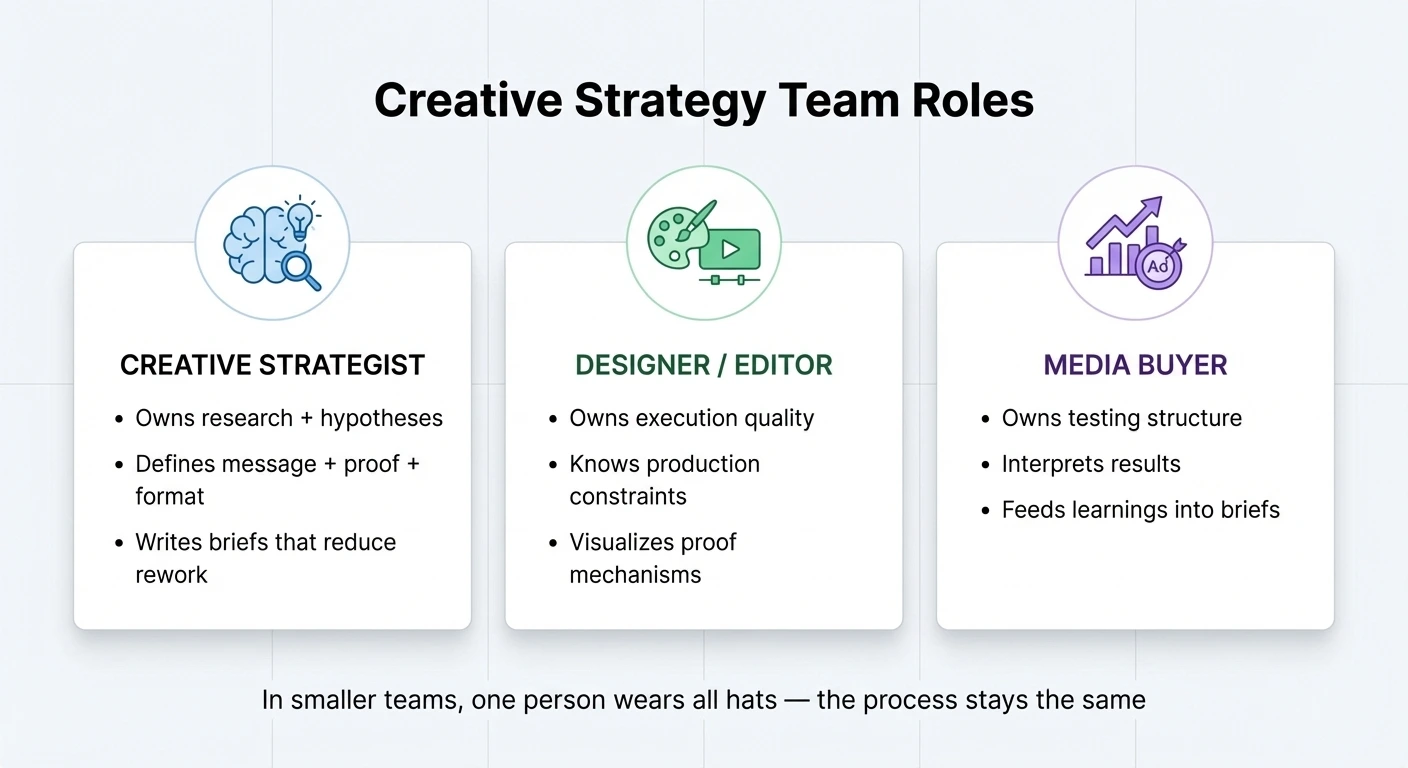 How responsibilities split across a typical in-house performance team.
A simple creative strategy framework performance teams can run
You don’t need a complicated model. You need a repeatable cycle that connects research → production → measurement → iteration.
1) Inputs (research)
Start each cycle with a small set of inputs:
- Customer reality: reviews, tickets, call notes, objections, “why I didn’t buy”
- Competitor reality: what’s being scaled, what runs long, what’s repeated
- Account reality: what already worked for you (and why)
Keep the goal narrow: you’re not writing a thesis. You’re deciding what to make next week.
2) Hypothesis (what should work and why)
Write one sentence:
“For [audience], the angle [X] with proof [Y] in format [Z] will improve [metric] because [reason].”
This prevents random “let’s try a bunch of stuff” production.
3) Brief (turn hypothesis into assets)
A good brief reduces interpretation. Include:
- Opening hook options
- Core claim (one)
- Proof mechanism (one)
- Script beats / frame-by-frame outline
- CTA and landing-page alignment notes
- Required variations (more on this below)
4) Ship variations (not just one ad)
Winning ads usually come from a cluster of related variants:
- 3–5 hook variants
- 2 proof variants
- 2 format variants (when relevant)
- 2 language versions (if you scale EU)
5) Measure and decide what to do next
Creative strategy is decision-making. Every batch should end with:
- “Kill”
- “Iterate”
- “Scale”
- “Translate/adapt to new market/placement”
The point is not to admire dashboards. It’s to produce the next better set of ads.
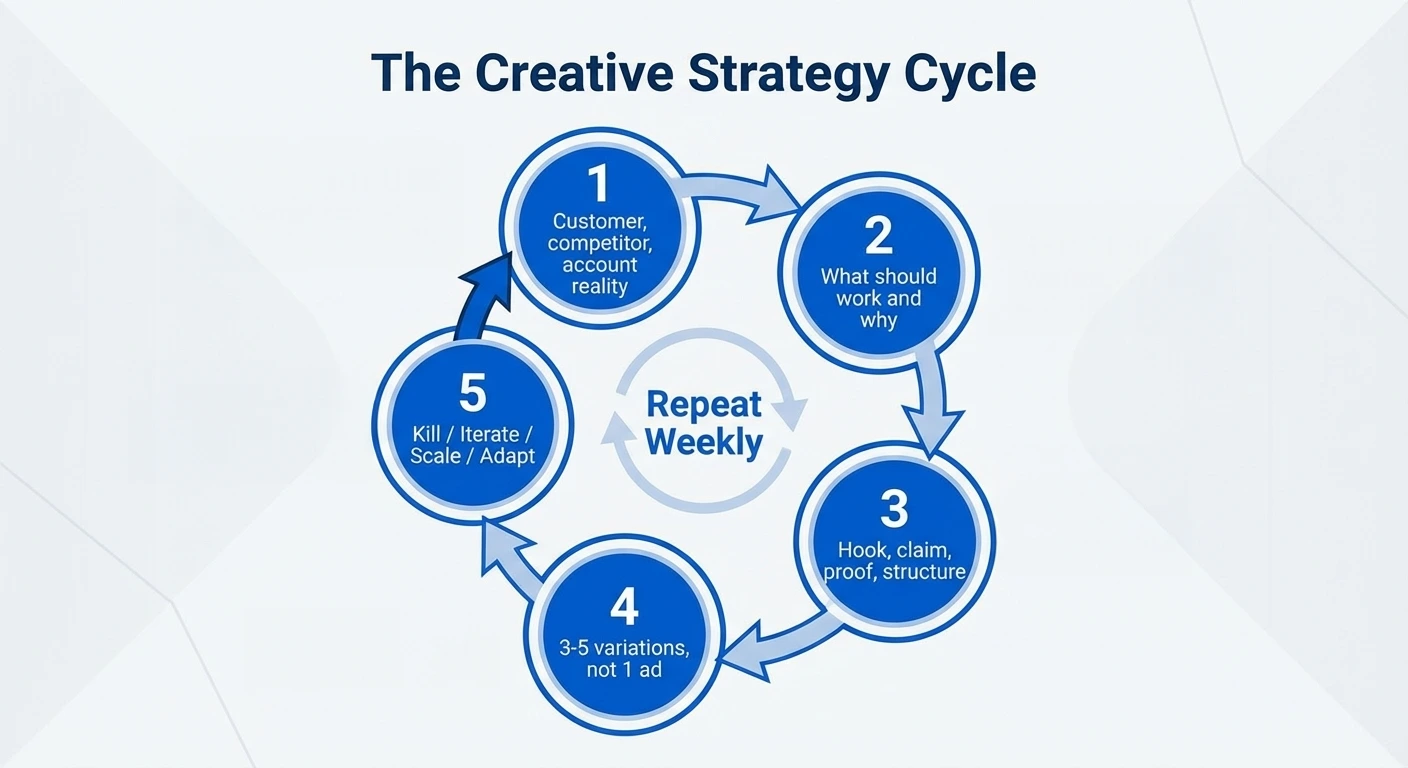 The repeatable cycle that connects research to production to measurement.
What to measure (and why ROAS alone isn’t enough)
ROAS is important, but it’s a lagging indicator. Creative strategy works better when you watch a few leading indicators that tell you where the ad is failing:
- Attention (early): did people stop at all?
- Engagement (mid): did the narrative hold?
- Intent (late): did it generate clicks and conversion momentum?
- Durability: did it keep working long enough to matter?
- Transferability: can you scale the concept across audiences, placements, and markets?
You can keep it simple by aligning your indicators to the funnel stage:
- Hook / first seconds (for video): early retention signals
- CTR / outbound click rate: message clarity + offer strength
- CVR / CPA / ROAS: landing-page match + actual demand
- Time-live / longevity: whether it’s a real concept or a short spike
- Duplication across sets/audiences: whether the creative scales beyond one pocket
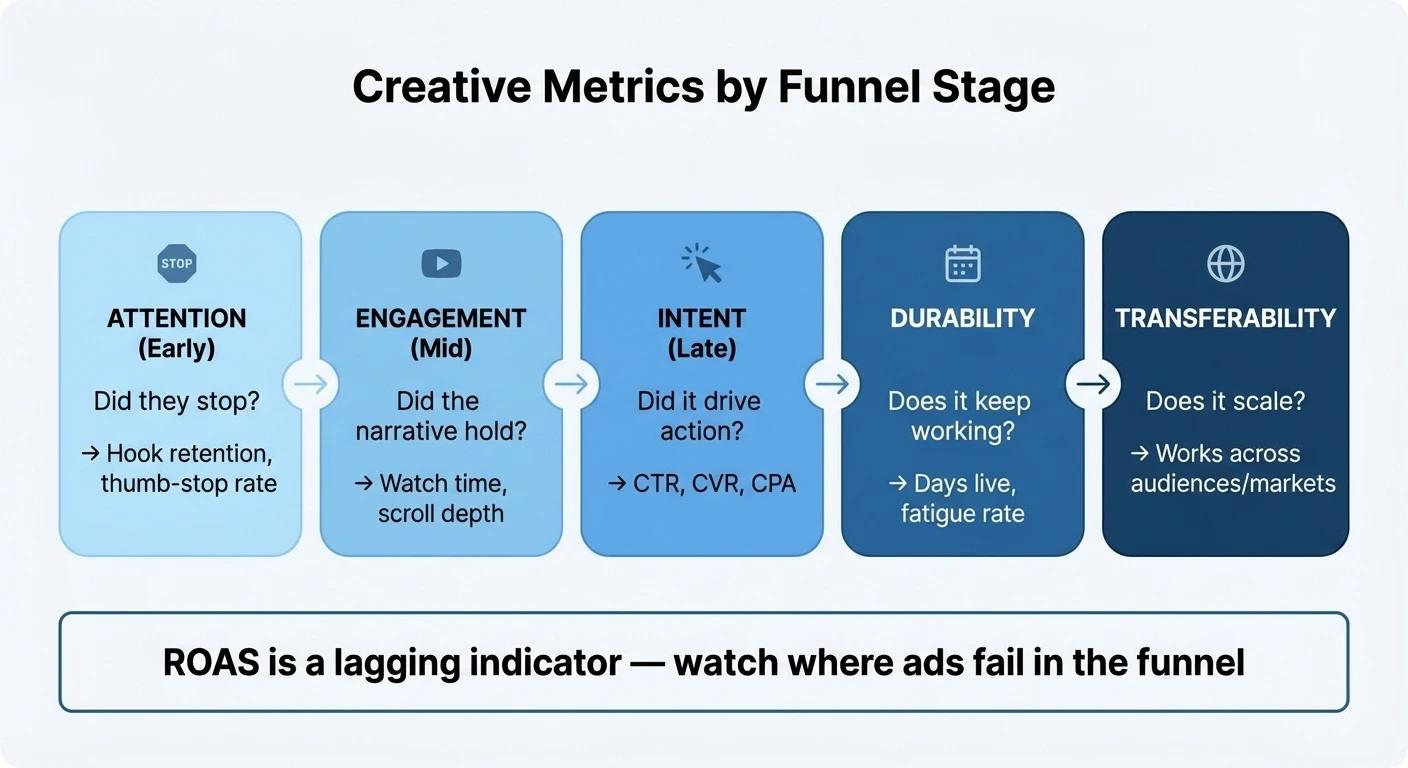 Map your metrics to the funnel stage where the ad might be failing.
Real data: what top EU/UK spenders are doing with creative
To keep this grounded, here’s a dataset pulled from 9 performance marketing brands spending €100k+/month on EU/UK ads.
Dataset summary: 17,136 active ads across 9 brands with 283M+ EU reach.
This is aggregated through Skaler’s Brand Spy feature, which aggregates creative patterns across a brand’s active ads. We recently published a deeper breakdown of these brands here:
Top EU & UK Performance Marketing Brands in 2025
1) Ad types: what’s actually working (by average reach)
| Ad Type | Ad Count | Avg Reach | Notes |
|---|---|---|---|
| Bundle Offer | 197 | 168,760 | Highest average reach |
| Before/After | 91 | 148,502 | Still scales |
| Testimonial | 561 | 87,939 | Scales well at volume |
| Product Showcase | 1,138 | 86,516 | Workhorse format |
| Features/Benefits | 1,575 | 77,707 | Most common, steady |
| Sale/Discount | 1,922 | 36,730 | High volume, lower reach per ad |
Across 17,000+ active ads from top EU spenders, bundle offers achieve ~4.6x higher average reach than discount ads (168K vs 37K).
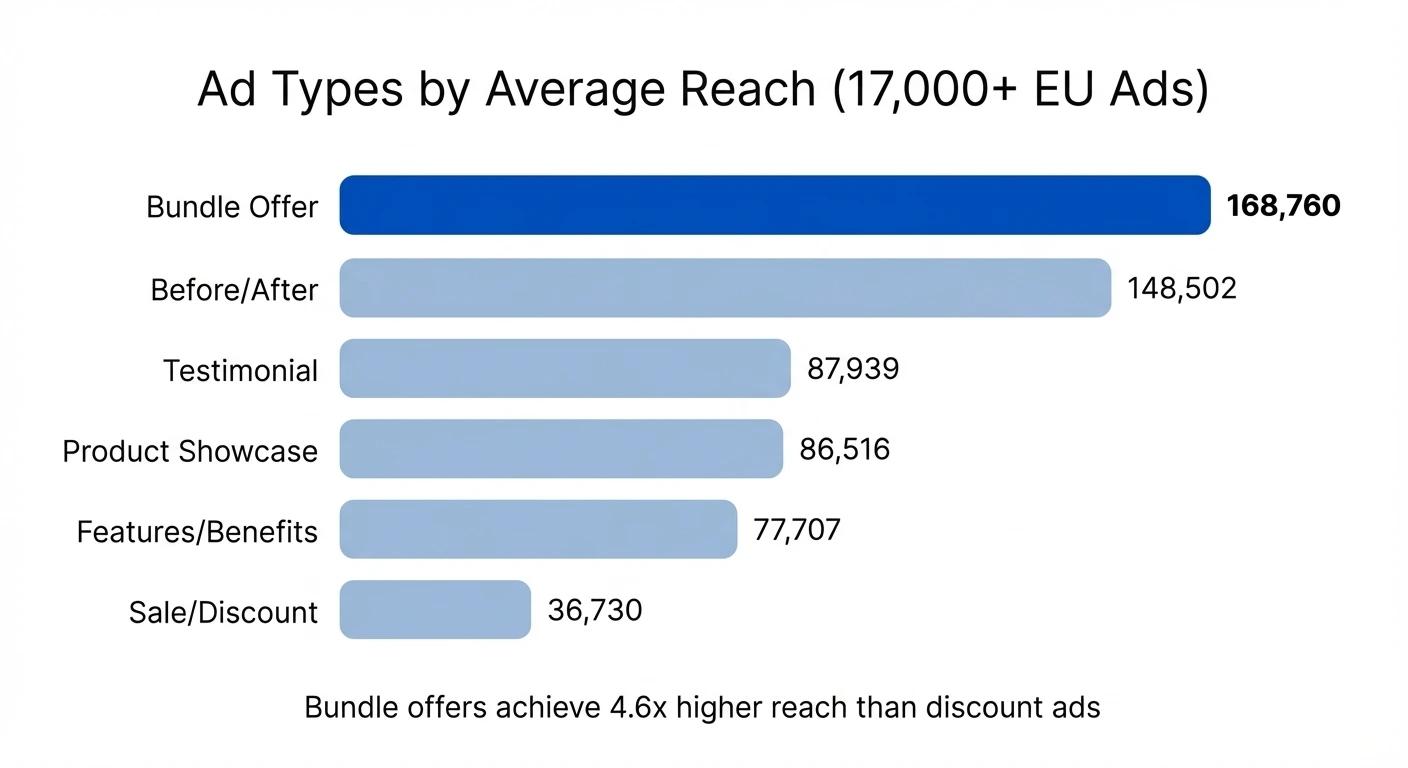 Ad type performance ranked by average reach across 17,000+ active ads.
2) Duplication: scaling isn’t always “new creative”
| Duplication | Active Ads | Avg Reach | Total Reach |
|---|---|---|---|
| Unique (1x) | 5,531 | 24,174 | 134M |
| 2–3x | 2,260 | 31,599 | 71M |
| 4–5x | 2,690 | 15,935 | 43M |
| 6–10x | 2,451 | 5,614 | 14M |
| 10x+ | 4,204 | 5,186 | 22M |
Ads duplicated 2–3x achieve ~31% higher average reach than unique creatives.
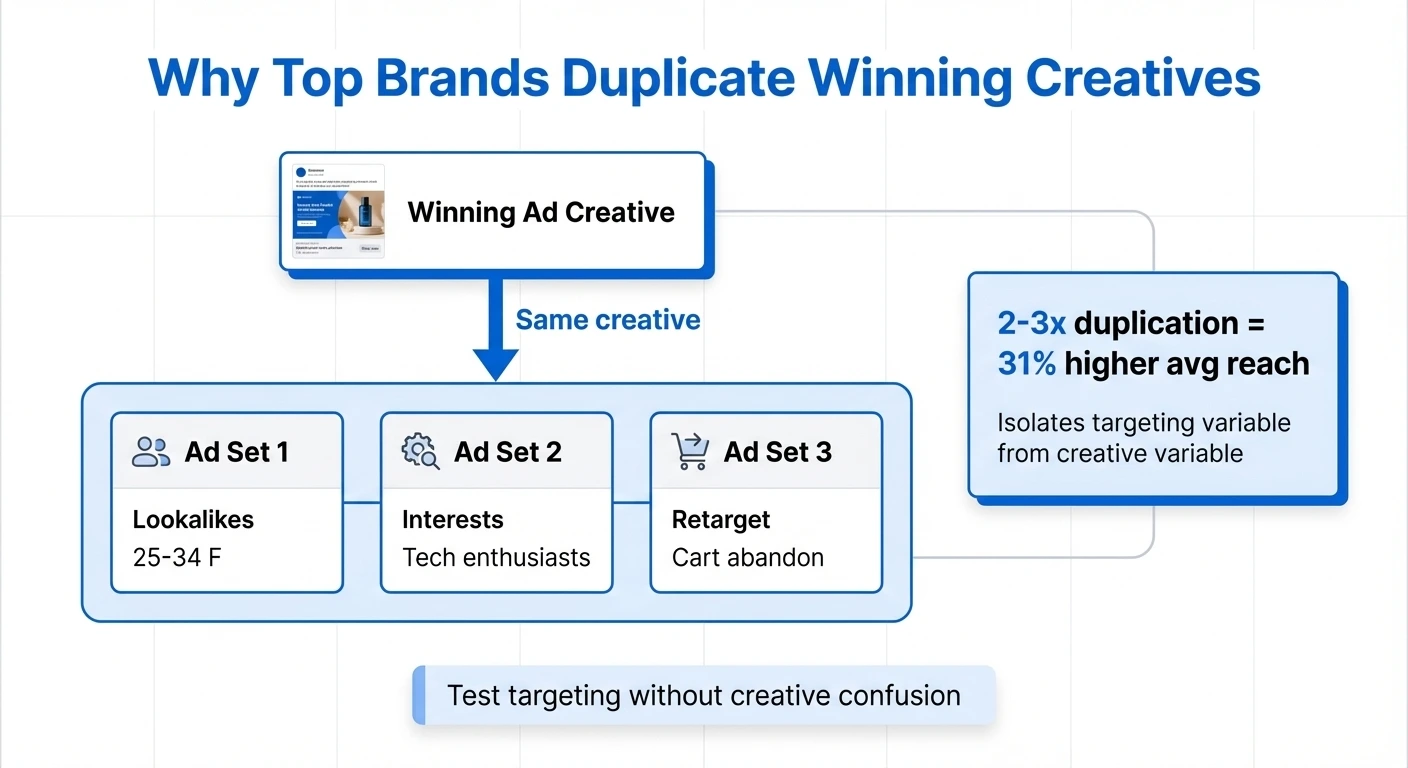 Top brands run the same winning creative across 2-3 different targeting contexts.
3) Longevity: winners run longer than most teams expect
| Age | Active Ads | Avg Reach | Total Reach |
|---|---|---|---|
| < 1 week | 2,399 | 8,011 | 19M |
| 1–4 weeks | 9,813 | 4,432 | 43M |
| 1–3 months | 4,026 | 30,673 | 123M |
| 3–6 months | 741 | 105,880 | 78M |
| 6+ months | 157 | 120,315 | 19M |
Ads running 3–6 months average ~24x more reach than ads under 1 week old.
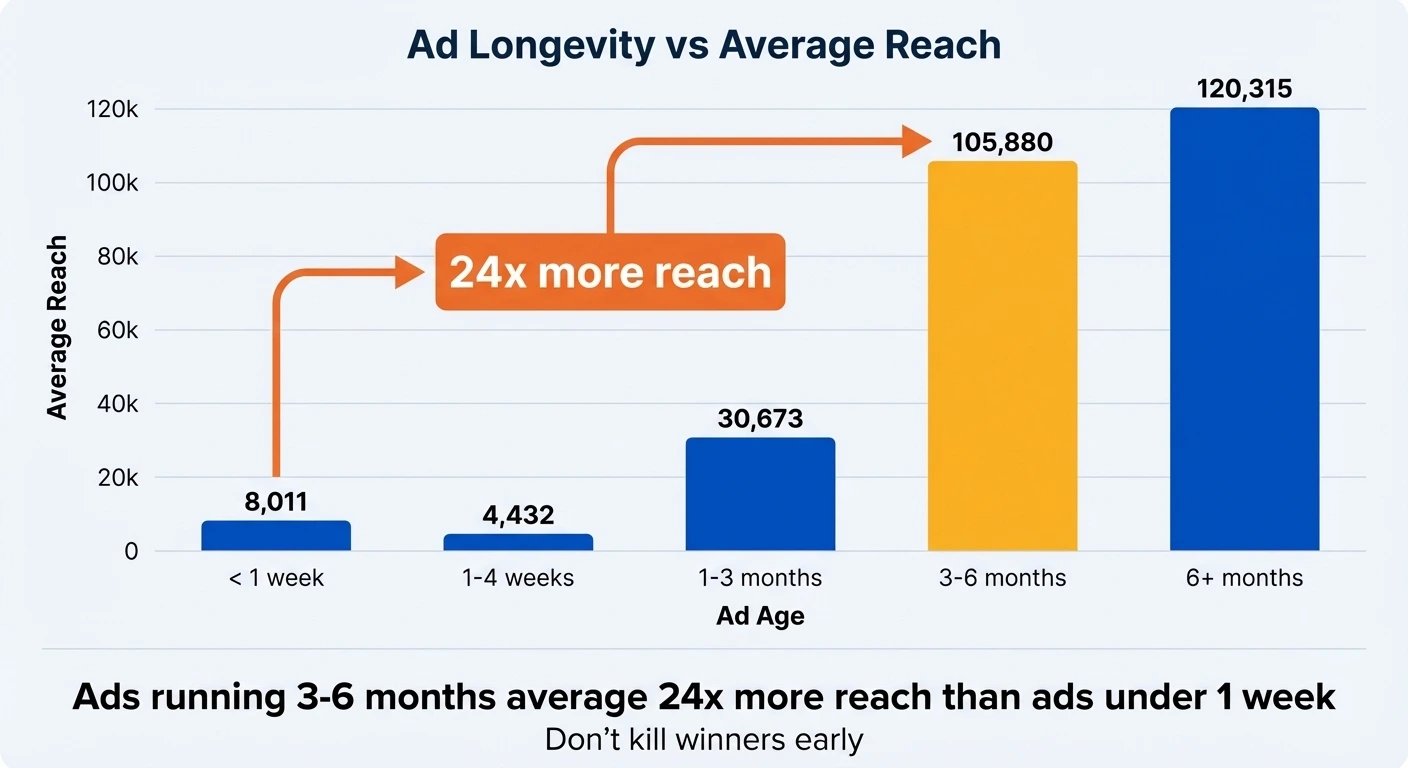 Ads that survive longer accumulate dramatically more reach. Don't kill winners early.
4) Images vs videos
- Images: 11,240 ads (65.6%) — 155M reach
- Videos: 5,896 ads (34.4%) — 128M reach
Despite the “video is king” narrative often pushed in guides (including TikTok’s own Creative Best Practices), images still dominate volume at scale—largely due to speed and ease of localization.
5) Localization patterns
| Language | Ads | Brands Using |
|---|---|---|
| English | 28,015 | 9/9 |
| French | 1,405 | 8/9 |
| German | 1,249 | 7/9 |
| Spanish | 308 | 6/9 |
| Italian | 74 | 6/9 |
| Dutch | 212 | 2/9 |
EU scale rewards teams that treat localization as production, not translation.
Creative strategy for Meta
Meta rewards creative that produces clean, learnable signals—especially under broader targeting and automation (Meta Advantage+).
Practical implications:
- Treat hooks as testable inputs, not decoration
- Scale concepts through variations, not constant reinvention
- Duplicate winners intentionally (2–3 contexts often outperform unique one-offs)
- Let strong ads run longer than your instincts tell you to
Creative strategy for TikTok
TikTok creative strategy tends to hinge on:
- Speed of iteration
- Cultural and native-feeling execution
- Immediate clarity in the opening moments
TikTok’s own guidance in the Creative Center consistently emphasizes clear hooks, simple narratives, and volume of testing—principles that map directly to a disciplined creative strategy.
Creative strategy examples
Example 1: Ecommerce bundle offer
- Audience: Value-conscious buyers
- Angle: “The bundle is the smarter way to start”
- Proof: Cost-per-use, what’s included, reviews
- Formats: Static bundle grid + short unboxing video
Example 2: App subscription (before/after)
- Audience: Skeptical first-time users
- Angle: “Small daily use, visible outcome”
- Proof: User story + measurable change
Example 3: EU scaling via localization
- Audience: French & German cold traffic
- Angle: Same winning concept, localized proof
- Proof: Local reviews, localized UI, local shipping/returns
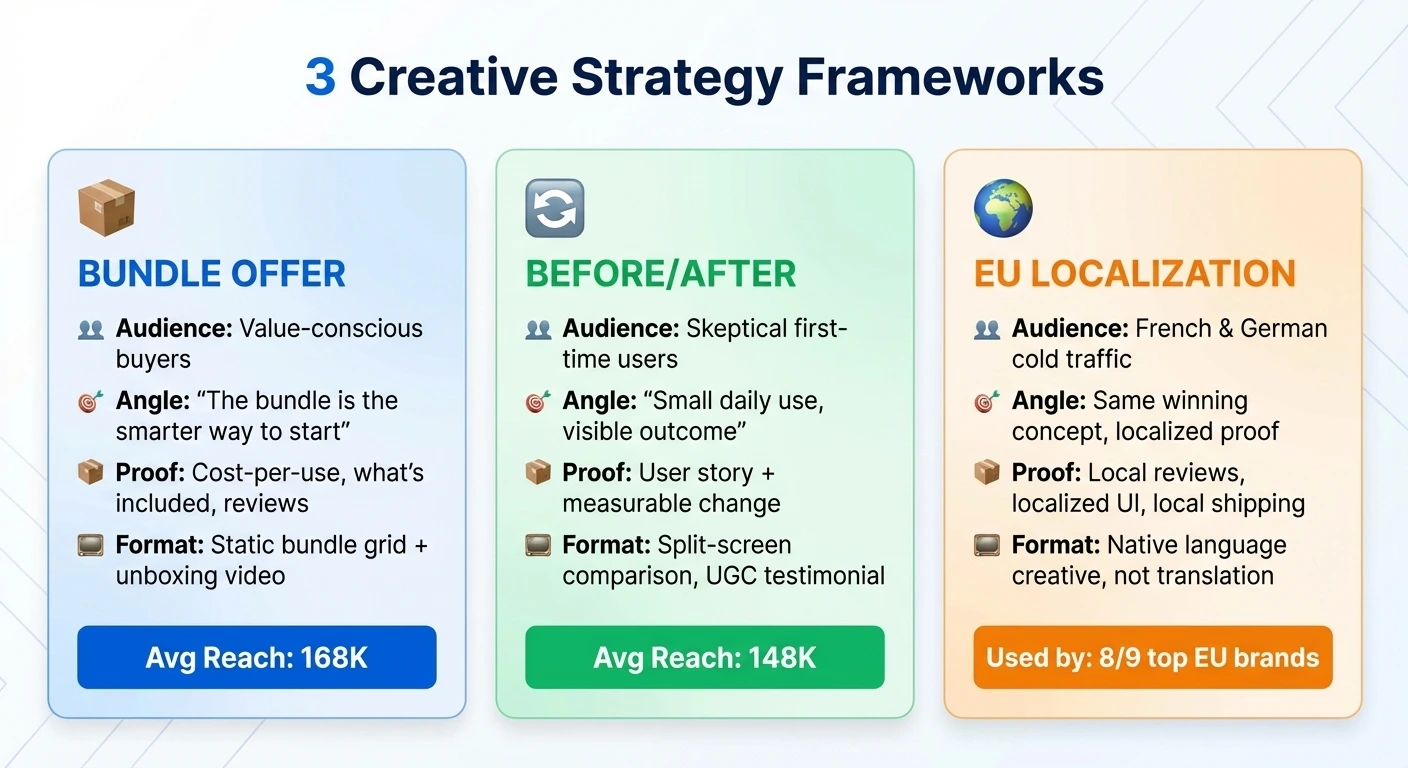 Three strategy frameworks commonly used by top EU performance brands.
Real ad examples from top EU brands
Bundle offer examples (avg 168K reach):
Before/after examples (avg 148K reach):
Testimonial examples (avg 88K reach):
Creative strategy template (copy/paste)
Goal:
Audience:
Core problem:
Primary angle:
Core claim:
Proof mechanism:
Format + structure:
Hook options (3–5):
Mandatory variations:
Landing page alignment:
Success metrics:
Next action rules:
Two ways to use competitive signals strategically
-
Study what gets repeated
If a creative is duplicated across multiple contexts, it’s often because the message travels. -
Study what survives
Ads that run for months tend to be clear, not clever. Longevity is a creative signal worth respecting.
(Internally, we use aggregated brand-level data to surface these patterns quickly, but the principle applies regardless of tooling.)
Common creative strategy mistakes
- Treating strategy as brainstorming
- Shipping single ads instead of structured variation sets
- Over-optimizing for novelty
- Treating localization as an afterthought
FAQs
What does a creative strategist do?
They turn research into hypotheses, briefs, and iteration plans that the team can execute weekly.
Is creative strategy only for ads?
No, but paid ads force fast feedback, which makes strategy gaps visible quickly.
How often should creative strategy change?
The structure stays. The inputs, angles, and proof evolve.
Creative strategy is how performance teams stay consistent without becoming repetitive. When it’s treated as a system—not a brainstorm—it becomes one of the most durable advantages an in-house team can build.
Related Resources
- Top 9 Brands Crushing EU/UK Facebook Ads — Real examples from brands spending €100K+/month
- Static Ads in 2025: 25+ Examples — Patterns, templates, and testing framework
- Facebook Ads Not Converting? 15 Fixes — Diagnose why your ads aren't working
- 5 Ad Creative Best Practices — Strategies that drive conversions
- Meta Ads Library: Complete Guide — Research competitor ads for free
Ready to build your creative strategy system? Start free with Skaler
Related Articles
The 80 Most-Saved Meta Ads of August 2026 (Free Swipe File)
We tracked the 80 Meta ads media buyers saved the most this month — from Seed and Loop to AI soap operas running across 9 ad sets. Browse all 80 free, plus the 4 patterns behind them.
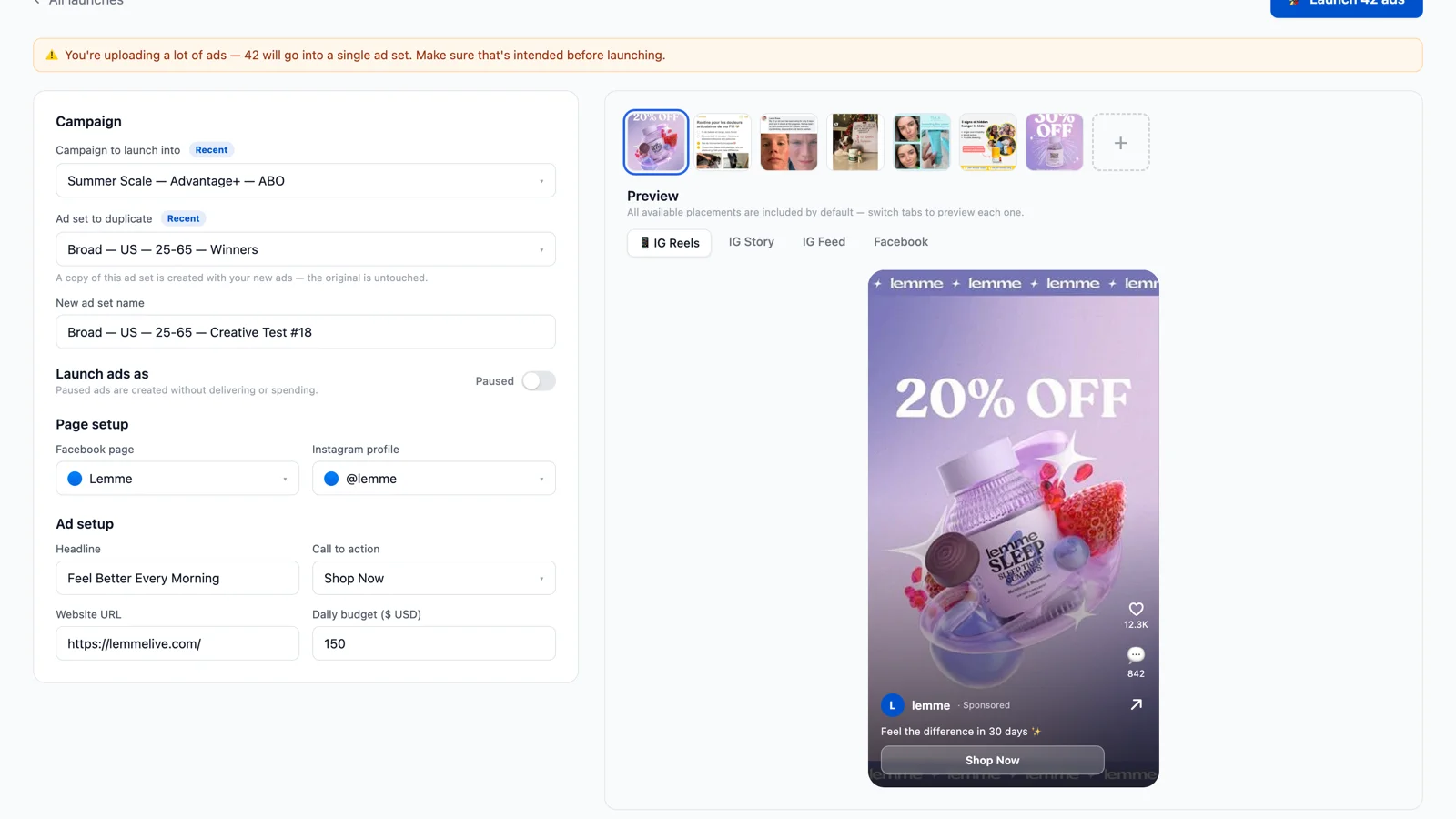
Bulk Ad Launcher for Meta: Launch 100 Facebook Ads in One Click
Skaler's new Bulk Ad Launcher takes you from creatives to live Facebook ads in minutes — drag and drop up to 100 files, duplicate a winning ad set, and launch with copy, budgets, and tracking auto-filled.