
Manus AI Blocked: What Performance Marketers Should Use for AI-Powered Meta Ads in 2026
Beijing just ordered Meta to unwind its $2B Manus AI acquisition. Here's what performance marketers should know, and the AI agent alternative built specifically for Meta ad accounts.

 Follow on LinkedIn
Beijing just told Meta to unwind its $2B Manus acquisition. If you were planning to plug an AI agent into your Meta ad account, the calculus just changed. Here's what to use instead.
TL;DR: China's National Development and Reform Commission blocked Meta's $2B acquisition of AI agent startup Manus on April 27, 2026. Manus had recently shipped a Meta Ads integration billed as a "professional AI ads analyst inside your Manus workspace." For performance marketers, the immediate question is: what's the AI agent alternative for Meta ads now? Skaler AI Agent is in early access today, built as an official Meta app, on top of real ad-account data, for performance marketers running large accounts.
On April 27, 2026, China's National Development and Reform Commission ordered Meta to unwind its $2 billion acquisition of Manus, the Singapore-headquartered AI agent startup that went viral in March 2025 with autonomous task-execution demos. Beijing's reasoning, per analysts: even though Manus restructured out of China into Singapore last year, its core IP, data, and engineering talent originated in Beijing, and the regulator wasn't going to let "Singapore washing" slide.
For most readers, this is a geopolitics story. For performance marketers, it's an immediate product question.
In December, Manus had announced an integration with Meta's advertising tools, framed as "having a professional AI ads analyst directly within your Manus workspace." That was a nontrivial slice of Manus's pitch to performance marketing teams. With the deal blocked and the Meta-side product now in limbo, anyone who was about to adopt it needs an AI agent alternative for Meta ads, and they need one that won't get their ad account flagged.
This post covers what just happened, why the Manus path was always architecturally risky for marketers, and what to use instead.
What happened with the Meta-Manus deal?
On April 27, 2026, China's NDRC formally blocked Meta's planned $2B acquisition of Manus and demanded the parties unwind the transaction. Meta had announced the deal in December 2025; Beijing opened its review shortly after and concluded that Manus's Chinese-origin IP, data, and talent could not legally transfer offshore through Singapore restructuring. Meta said the transaction "complied fully with applicable law" and is seeking resolution.
Three signals worth noting:
- It's the first invocation of China's foreign investment security rules introduced in late 2020, per CNBC's analysis. That makes it precedential, not a one-off.
- The Meta-side products built on Manus are now in limbo. The Meta Ads integration that Manus had announced was designed for a future where Manus would be a Meta-owned product. That future just got blocked.
- "Singapore washing" is dead as a regulatory hedge for Chinese AI startups. If you were betting on Manus as a long-term AI agent platform, that bet got materially worse in 24 hours.
Meta has not publicly announced what happens to the Manus Meta Ads integration, but the practical expectation across the industry is that anything built on a Chinese-origin agent platform is now going to face additional scrutiny, regardless of where the legal entity sits.
What was Manus actually offering for Meta advertisers?
Per Manus's own December announcement (referenced in Business Insider's coverage), the Meta Ads integration was pitched as an embedded AI ads analyst inside the Manus workspace, capable of pulling campaign data and generating analysis on demand. In practice, this meant connecting your Meta ad account to a general-purpose AI agent built on third-party LLMs (Manus runs on Anthropic's Claude, among others) and asking it questions about your campaigns.
Useful in concept. Architecturally fragile in execution. Three issues stack up:
- General-purpose agents weren't built for ad accounts. They handle a stock-picking demo and a vacation-planner demo equally well, which means they handle nothing exceptionally. Real ad accounts have 200, 500, 5,000 active ads; tens of thousands of inactive ones; nested campaign/ad-set/ad hierarchies; and breakdowns by placement, age, gender, country, day-of-week. Generic agents choke on this scale long before they produce useful output.
- The connection method matters. When you plug a general-purpose agent into Meta's API through an MCP server or a third-party connector, you're authenticating as a developer or user, not as an approved Meta integration. Meta's review systems can and do flag accounts that connect through unapproved channels.
- The agent has no creative context. A general-purpose agent can read your spend, CPM, CTR, and ROAS. It can't tell you why a hook is fatiguing, which visual format converts in your category, or what your competitors just shipped, because it doesn't have that reference data.
For a sub-$10K/month account run by a solo founder, point 1 isn't fatal; the agent works because the data volume is small. For media buyers running $100K-$500K+/month, all three points are dealbreakers.
What does this mean for performance marketers in 2026?
The Meta-Manus block doesn't kill the AI agent thesis for performance marketers, it just rules out one specific path. The thesis is still right: a chat interface that pulls your ad-account data, ranks creatives, surfaces fatigue, and generates new variations is going to be how teams operate by 2027. The question is which AI agent you trust with OAuth access to your Meta ad account, and which one was actually built to handle a real performance-marketing workload.
The constraints that matter:
- Official Meta app status. Approved integrations go through Meta's review process, register the app, and use proper OAuth flows. Unapproved tools that bridge Claude or GPT to Meta's API through an MCP server are exactly the pattern Meta's security systems flag. If your account gets restricted because an unsanctioned tool was reading from it, the agent's "Anthropic-grade reasoning" doesn't get your ads back online.
- Built for the data shape. Performance marketing data is wide (200+ creatives), nested (campaign → ad set → ad), and noisy (attribution gaps, settling delays, post-iOS underreporting). Generic agents don't model this; they treat your ad account like a flat spreadsheet. Purpose-built tools index every creative, AI-tag it, and rank it before the agent sees the question.
- Closed-loop workflow. Reading metrics is the easy half. The hard half is generating new creative based on what just won, in a single conversation, without bouncing the user between three different tools. Agents that stop at "here's what's working" leave the production work undone.
The brands shipping the most ad creative in 2026 are running this loop daily. The ones still copying CSV exports into ChatGPT are losing.
🤖 Skaler AI Agent is live in early access. It's built as an official Meta app, on top of an index of ~3M Meta ads, for accounts running real spend. Get early access →
What's the AI agent alternative for Meta ads?
For performance marketers who need an AI agent that connects to a Meta ad account today, Skaler AI Agent (live in early access) is the closest fit to what Manus had pitched, with three differences that matter for ad accounts: it's an official Meta app (real OAuth, no MCP-server workarounds), it's built specifically for creative analytics (not a general-purpose assistant), and it runs the full analyze-optimize-generate loop in a single chat thread.
Three things make it different from a Claude-or-GPT-plus-MCP-server setup:
-
Real-time competitor analysis baked in. The same chat thread can pull your account data and analyze any competitor's last-week ad strategy, because Skaler indexes ~3M public Meta ads with AI tags for hooks, ad types, copy lines, and visual elements. Generic agents don't have this reference set, so they can't answer "what's AG1 doing this week" without an external scraper.
-
Built for large accounts from day one. Generic AI agents fall over at a few hundred ads. Skaler was designed around accounts running 1,000+ active creatives, with the data layer (indexed, scored, ranked) sitting beneath the chat.
-
Closed-loop production. Reading metrics is half the job. Skaler's agent can generate new ad variations, image and video, based on what's actually winning in your account, inside the same conversation. Manus's pitch stopped at analysis.
Here's what running an AI agent on a real Meta account actually unlocks. Three of the prompts the Skaler AI Agent handles in early access today:
"Analyze AG1's last week's strategy." The agent pulls every active AG1 ad from the public Meta Ad Library, tags it by hook, ad type, and creative format, and summarizes what's winning. AG1's actual playbook right now: celebrity-testimonial videos, with Hugh Jackman opening on hooks like "I demand a lot of my body" and "I want to make the most of every day." The agent surfaces the pattern in seconds, not the hour it would take you to scroll the Library by hand.
Four currently-active AG1 ads pulled from the Skaler index. Three are Hugh Jackman testimonial videos with different hooks (the "demand a lot", "feeling my best", and "make the most of every day" angles); one is an Austin Smith testimonial. The pattern is consistent: celebrity testimonial + busy-life framing + simple-nutrition CTA. That's the kind of summary the agent produces in a single response.
"Based on last week's results, create new ad optimizations." The agent reads your own ad account (via official Meta OAuth), identifies which creatives are scaling and which are fatiguing, and generates new image or video variants based on what's winning. The output isn't generic copy; it's grounded in the specific hooks, formats, and angles that just performed in your account.
"Which visual formats performed best in my ad account?" The agent runs creative-level analysis across your active set, breaks formats out by spend, ROAS, and creative fatigue, and tells you what's working before Monday's standup. No CSV exports, no pivot tables, no "let me get back to you on that."
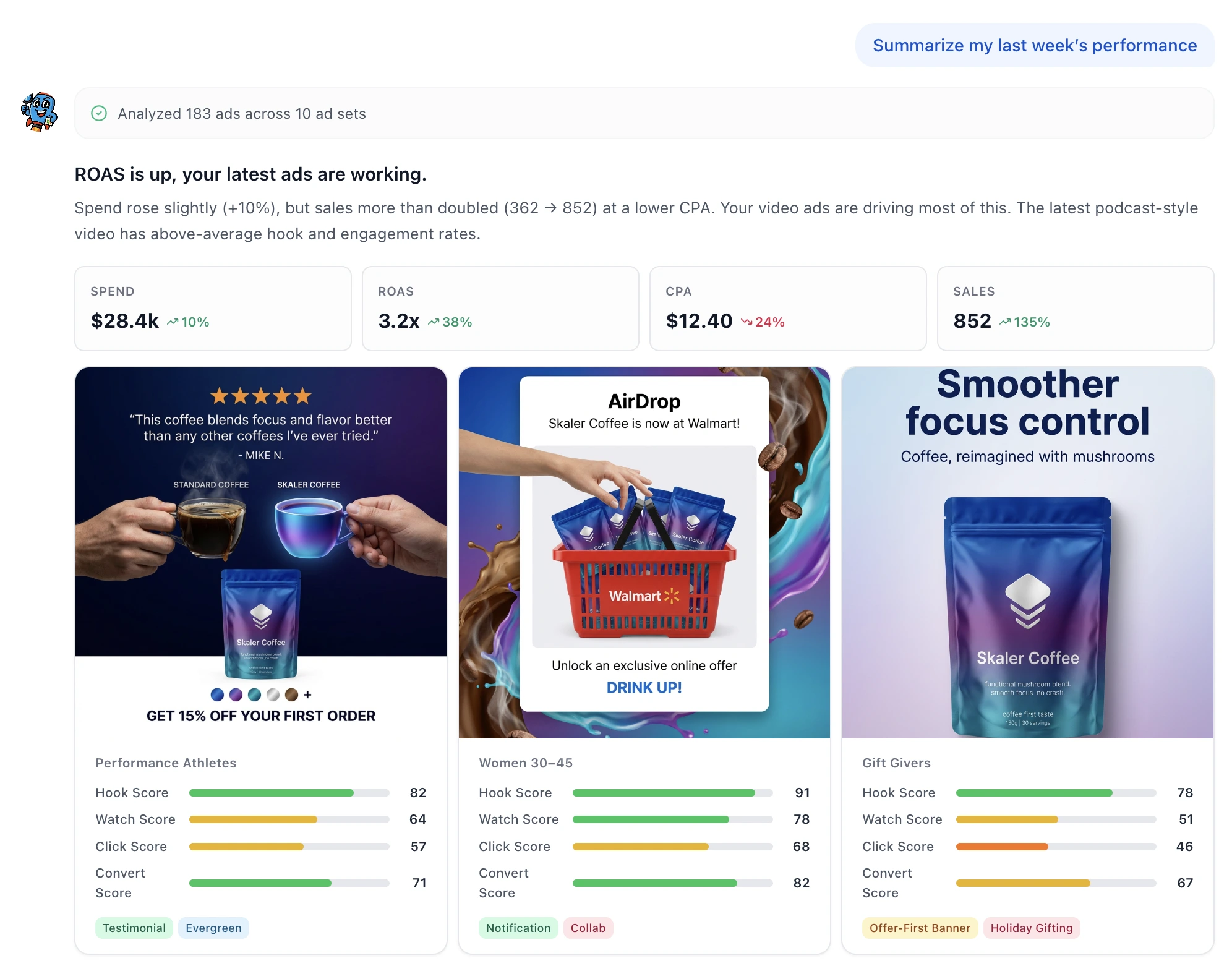 The interface is a single chat thread. The data layer beneath it is everything Manus's general-purpose agent would have needed to build before becoming useful for ads.
Skaler AI Agent vs. plugging Claude into your Meta account
The two architectures look similar from the outside (a chat interface that knows about your ads) and diverge sharply on the things that matter for a real ad account: OAuth integrity, scale, creative reference data, and the analyze-to-generate loop.
| Capability | Generic agent + MCP server | Skaler AI Agent (early access) |
|---|---|---|
| Official Meta app status | ❌ Connects via developer/user OAuth or MCP | ✅ Approved Meta app with real OAuth flow |
| Built for performance marketing | ❌ General-purpose | ✅ Purpose-built for ad creative analytics |
| Handles 1,000+ active creatives | ❌ Chokes at a few hundred | ✅ Designed for large accounts from day one |
| Competitor ad index | ❌ None (or scraped on demand) | ✅ ~3M Meta ads indexed and AI-tagged |
| Generates new ad variants | ❌ Analysis only | ✅ Image and video generation in-thread |
| Risk of account restriction | ⚠️ Higher (unsanctioned API access) | ✅ Lower (Meta-approved integration) |
That last row is where most marketers get hurt. An ad account that gets flagged for unsanctioned API access can take days or weeks to recover. The "save 5 minutes by piping Claude into your account" trade is not worth it for any account running real budget.
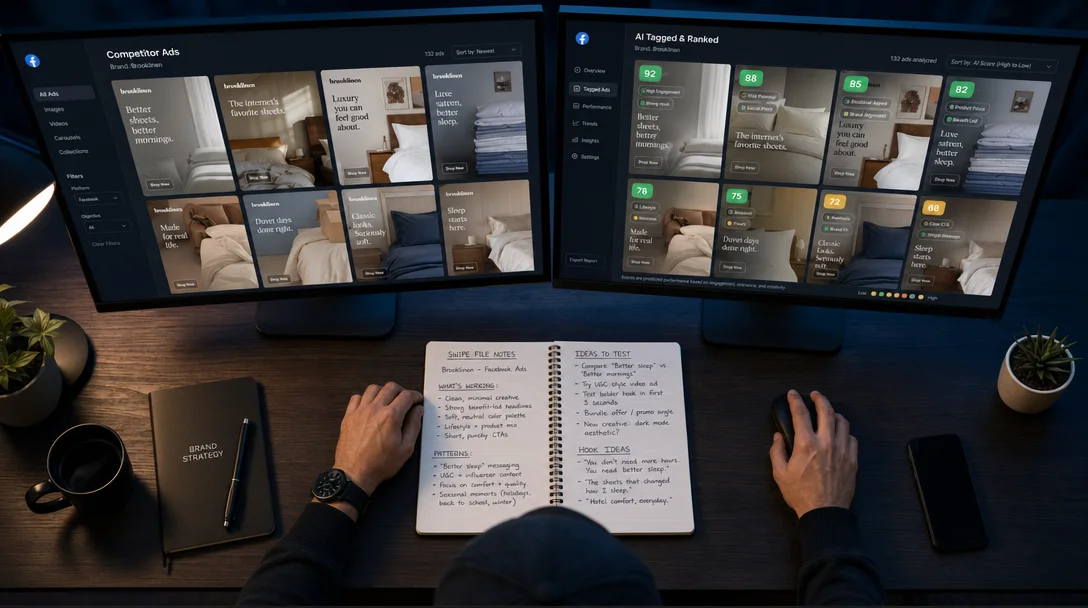 The data layer is what separates a useful ad-account agent from a generic one. AI tags, performance scores, hook extraction, and ad-type classification all happen before the chat sees the question.
Frequently Asked Questions
Why did China block Meta's Manus acquisition? On April 27, 2026, China's National Development and Reform Commission ruled that Manus's Chinese-origin IP, data, and engineering talent could not be effectively transferred offshore through Singapore restructuring, per CNBC. It's the first time Beijing has used the foreign investment security review measures introduced in late 2020.
What was Manus's Meta Ads integration? Manus announced an integration with Meta's advertising tools in late 2025, pitched as "having a professional AI ads analyst directly within your Manus workspace." With the Meta-Manus deal now blocked, the integration is in limbo and Meta has not publicly committed to a replacement.
Is plugging Claude or GPT into my Meta ad account safe? It depends entirely on how you connect. Approved Meta apps using the official OAuth flow are safe and routine. Connecting an LLM through an unapproved MCP server, browser extension, or scraping setup is exactly the pattern Meta's security systems flag, and ad accounts have been restricted for it. Stick to integrations that have gone through Meta's app review.
What's the best AI agent for Meta ads in 2026? For performance marketers running real spend, the requirements are: official Meta app status, an indexed creative reference set (not just LLM general knowledge), and the ability to generate new creative based on what's winning. Skaler AI Agent (live in early access) is built specifically for this; general-purpose agents like Manus or Claude-via-MCP weren't.
Can I get early access to Skaler AI Agent? Yes. The agent is live in early access for anyone who signs up through skaler.app/auth. Access is unlocked on the account you register, no waitlist or invite code needed.
The takeaway
The Meta-Manus deal was a bet that a general-purpose AI agent could be retrofitted into a performance marketing tool. The bet got blocked by Beijing 4 months in. The underlying thesis (a chat interface that operates your ad workflow) is correct; the execution path Manus chose was always going to be fragile, and now it's in regulatory limbo.
If you were planning to plug Manus into your Meta account: don't. If you were planning to plug Claude into it through an MCP server: also don't. The right architecture is a purpose-built agent that's an approved Meta integration, sits on top of an indexed creative reference set, and runs the full analyze-optimize-generate loop in a single thread. That's what Skaler AI Agent is, and it's live in early access today.
Get Free Early Access to Skaler AI Agent
If you're running real spend on Meta ads and you've been waiting for an AI agent that actually understands your data, Skaler AI Agent is live in early access today. Built as an official Meta app, on top of ~3M indexed Meta ads, for accounts running large creative volumes. Get early access →
Related Resources
- Best Facebook Ad Reporting Tools for 2026
- Facebook Ads Not Converting? 15 Reasons Why
- How to Analyze Ad Performance: A Data-Driven Approach
- Creative Strategy: Frameworks, Templates, and Examples
- Meta Ads Library: The Complete Guide
- Facebook Ad Library 2026: What Meta Actually Shows
- Top 10 Performance Marketing Brands Running Ads in 2025
Related Articles
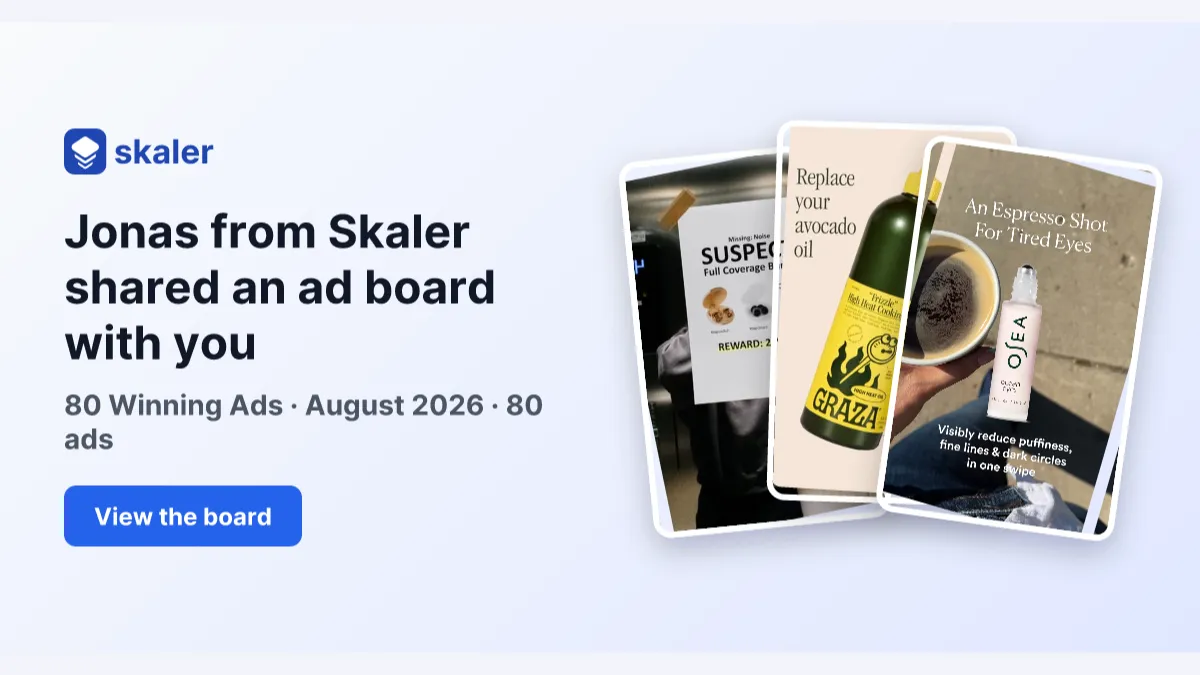
The 80 Most-Saved Meta Ads of August 2026 (Free Swipe File)
We tracked the 80 Meta ads media buyers saved the most this month — from Seed and Loop to AI soap operas running across 9 ad sets. Browse all 80 free, plus the 4 patterns behind them.
Bulk Ad Launcher for Meta: Launch 100 Facebook Ads in One Click
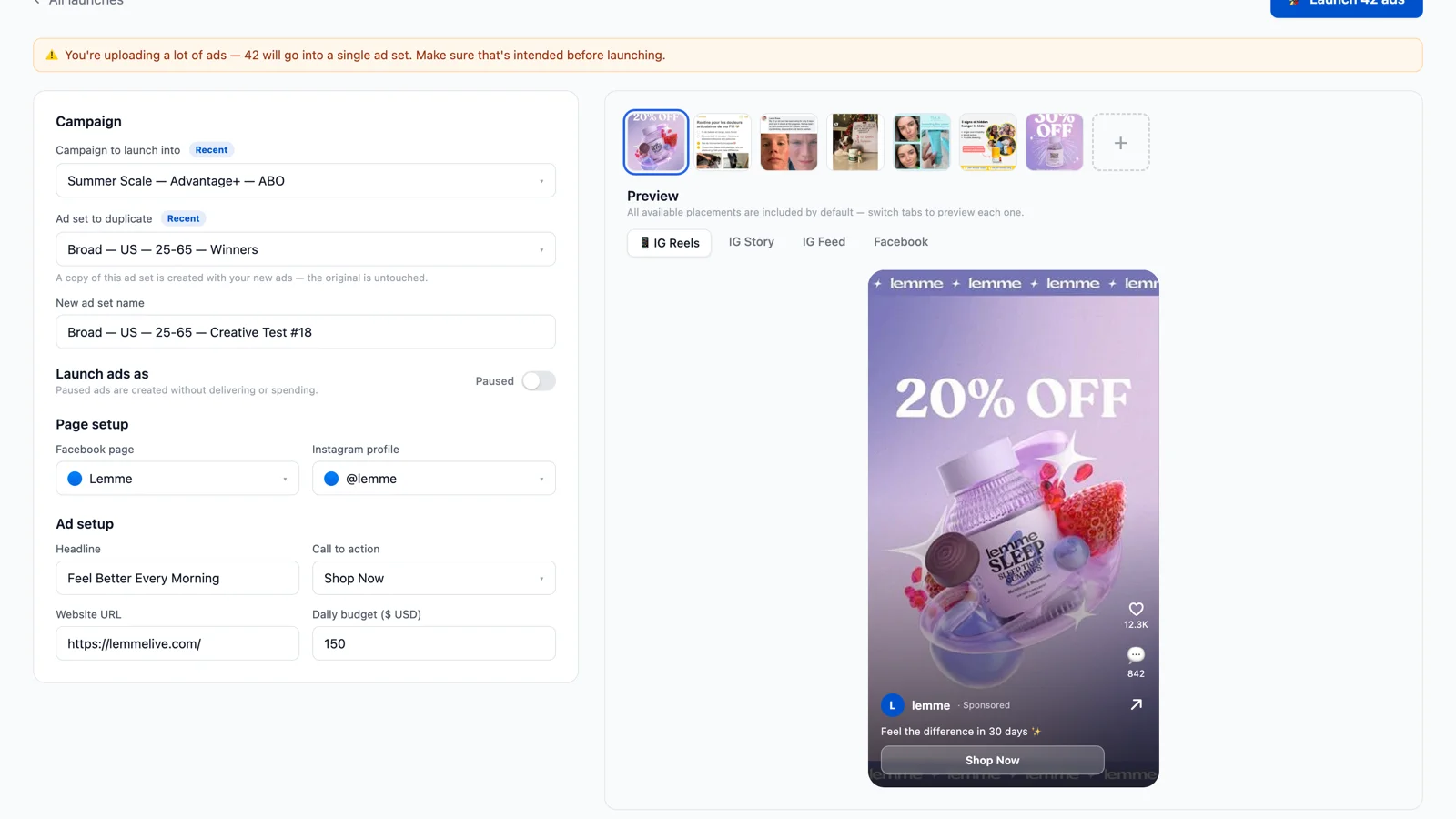
Skaler's new Bulk Ad Launcher takes you from creatives to live Facebook ads in minutes — drag and drop up to 100 files, duplicate a winning ad set, and launch with copy, budgets, and tracking auto-filled.